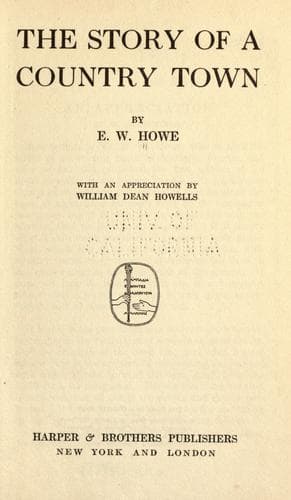
The Story of a Country TownHowe, E. W. (Edgar Watson)
General
The Story of a Country Town
Howe, E. W. (Edgar Watson)
Frontier and pioneer life -- Kansas -- Fiction
From him I learned that Agnes only came home during the two vacations of
the year, and that her mother was about the same with respect to visions
of poisoning and smothering, which humiliated them all very much except
Big Adam, who said he considered it an honor for the people to believe
that he would poison his mistress if he had opportunity, for they all
knew she deserved it. Mrs. Biggs and the children had changed but
little, except that the children had grown larger and more unruly, and
their mother more shrivelled than formerly. Big Adam was quite a novelty
in Twin Mounds, by reason of his great size and hoarse voice, and a
crowd always gathered at the office when he was there in the evening, to
hear him tell about the great farm he was expected to cultivate alone.
Although I was always hoping he would kill himself with dissipation,
Clinton Bragg continued to be only about as worthless as when I had
first known him, and there was no change in his manner except that he
made up with every old wreck who came to town, and induced him by treats
to listen to his brags about himself. Bragg came from a place somewhere
in the East which was given over to the manufacture of knives and forks,
and the three or four proprietors of the works comprised the
aristocracy. These, lacking better company, associated occasionally with
the small tradesmen and professional men of the town, which led them to
talk a great deal of the excellent society in which they moved, and
judging them by their representative in Twin Mounds, they became very
unpopular wherever they went, by reason of this unpleasant egotism. His
father, a hard-working but ignorant man, by close attention to the
business of keeping a keg house, had risen to the dignity of a merchant,
and was reputed to be well-to-do, although, as is usually the case, I
doubt if he had half the money with which he was credited.
Bragg considered this fork-making community as the greatest the world
had ever produced, and made himself very disagreeable in talking about
it. Being a great liar naturally, and as no one in Twin Mounds knew
differently, he used a citizen of the town where he had lived to traduce
citizens of Twin Mounds, and if a lawyer lost a case, or won it, he told
cheerful anecdotes of his brilliant friend Bighead, the leader of his
profession in Forkston. No difference what happened in Twin Mounds, it
reminded him of a friend of his in the town where knives were made, who
always did whatever was in hand in a much more creditable manner.
Public-domain text, read in full here on John Shaqi.
Reviews
Reviews
No reviews yet
Be the first to share your thoughts on this work.
Elsewhere in the archive
Join the Discussion
Join the discussion
Sign in to leave a comment or review.
Sign InorCreate an account