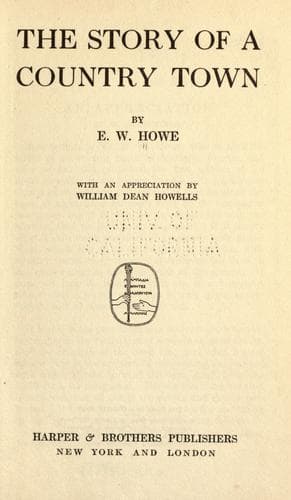
The Story of a Country TownHowe, E. W. (Edgar Watson)
General
The Story of a Country Town
Howe, E. W. (Edgar Watson)
Frontier and pioneer life -- Kansas -- Fiction
When he was drinking, he went about inquiring who Alexander Bighead was,
who Cornelius Deadhead was, who Elwyn Flathead was, who Godfrey Hardhead
was, or who Isaac Jughead was. Nobody being able to inform him (none of
them having ever been heard of outside of the community where they
lived), Bragg would answer that Alexander Bighead was a great lawyer and
a great drunkard, and that Cornelius Deadhead was as noted for his
knowledge of medicine as he was noted for his intemperance; that Elwyn
Flathead was a heavy trader, and a heavy drinker; that Godfrey Hardhead
was frequently on the public platform, and frequently in the gutter;
and that Isaac Jughead was as often on a spree as he was on the bench;
which argument was intended to convey the impression that all talented
men (Clinton Bragg included) drank more than was good for them.
Lytle Biggs, being a professional politician, was often in town, and as
has been the case when he first met me, he was of the opinion that while
I was a little delicate in asking him for the favor, I was burning with
impatience to hear more of his philosophy. I had enjoyed it very much at
first, and laughed a great deal at his oddities, and though it finally
grew tiresome, I could not very well flatly tell him so. Hence he came
in frequently when I was very busy, and when I knew he was not in a
philosophical humor, but reasoning that I had grown to expect it, and
had little other amusement, he consented to favor me with a few of his
thoughts. Thus it came about that he walked in one evening when I was
anxious to go home, and, seating himself, prepared to spend several
hours with me, though I could see he regarded himself as a martyr to be
compelled to instruct me in ordinary affairs which should be understood
at a glance.
“Speaking of the newspaper business,” he said, of which we were not
speaking at all, “I make considerable money advising the farmers to
patronize the ‘Rural Home,’ than which, in my opinion, a greater
literary thug never existed, but unfortunately for an oppressed people,
the publisher of the ‘Home’ (his name is Litch; it should be Leech) pays
liberal commissions, and I must live. I have a copy in my pocket; you
may examine it when there is positively nothing else to do.”
He handed it to me, and although it was folded, I saw on the first page
a picture of an animal so admirably proportioned that but little was
wasted in legs, being solid meat with the exception of a small head and
four pins to hold it up. By examining the note at the bottom, I found
it was a pig, although I should not have suspected it in the absence of
the statement, and that pairs of the breed could be had by addressing
the publisher, and enclosing money order or draft for fifty dollars.
Public-domain text, read in full here on John Shaqi.
Reviews
Reviews
No reviews yet
Be the first to share your thoughts on this work.
Elsewhere in the archive
Join the Discussion
Join the discussion
Sign in to leave a comment or review.
Sign InorCreate an account