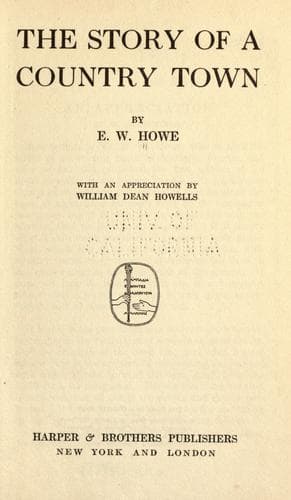
The Story of a Country TownHowe, E. W. (Edgar Watson)
General
The Story of a Country Town
Howe, E. W. (Edgar Watson)
Frontier and pioneer life -- Kansas -- Fiction
“If you should do yourself the injustice at some time in the future to
look it over,” Mr. Biggs continued, indicating that I was not to look at
it then, but to listen, “you would find it filled with all sorts of
ingenious appeals for the farmer’s money, and that the editor claims to
be poor, but honest, and oppressed by monopolies, like the rest of them.
But what are the hard, uncomfortable facts?”
I looked at him as if to say that I did not know what the facts were,
but had no doubt they were bad enough.
“The facts are that while the agricultural population is cooped up in
hot school-houses drinking spring water, and attending Alliance
meetings, the publisher of the ‘Rural’ is holding ice in his mouth at an
elegant club, only changing this delightful occupation to gulp down
expensive champagne. He lives in a villa, does this agricultural fraud
of the name of Litch, and makes a fortune every year; and, although he
earnestly advises the farmers’ wives and daughters to spend their spare
time in churning the butter and gathering the eggs, to buy good books to
improve themselves (P. S.--For which he is agent), he sends his own wife
and daughters to spend their spare time in summer at cool places, where
they may swim in the sea. That’s the kind of an oppressed citizen of a
groaning government Litch is, and I happen to know that he is the friend
of the monopolists he denounces, and that he is in their pay; that he is
the tool of the thieves who manufacture worthless machinery for farmers;
of the confidence men who advertise eggs, pigs and calves at a high
price, and that he is the worst enemy of the farmers generally.”
I pretended to be very much surprised at this, though I was not.
“If you should be caught in a lonely place on a rainy day, with no other
paper in your pocket than that, you would find a column of inquiries
with reference to agricultural matters addressed to the editor (who is
supposed to be informed, but who really gets all his information from
the agricultural departments of the metropolitan papers), each one of
which closes with a good word for ‘your noble,’ or ‘your brave,’ or
‘your widely circulated’ paper. The scoundrel writes them himself! And
there is another column from ‘Aunt Sue.’ He is also ‘Aunt Sue.’ In
short, he is everything except an honest man.”
Although I said nothing, I remembered that every farmer who moved to
Twin Mounds found out the agricultural papers, and denounced them; in
short, that everybody except the farmers knew what dreadful frauds they
were.
Public-domain text, read in full here on John Shaqi.
Reviews
Reviews
No reviews yet
Be the first to share your thoughts on this work.
Elsewhere in the archive
Join the Discussion
Join the discussion
Sign in to leave a comment or review.
Sign InorCreate an account