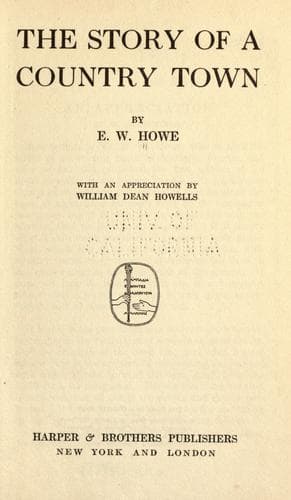
The Story of a Country TownHowe, E. W. (Edgar Watson)
General
The Story of a Country Town
Howe, E. W. (Edgar Watson)
Frontier and pioneer life -- Kansas -- Fiction
The skeleton which has found its way into my closet is very noisy now. I
think some one, out of consideration for me, has been trying to chain
him up, but he has broken loose, and drags his fetters about in the most
dismal manner. Either that, or he has company, and I am honored with two
skeletons. If other people have but one, I think I shall eventually have
two, if I have not now, and be compelled to enlarge my closet. I have
occasionally courageously unlocked my skeleton, and tried to look him
out of countenance, but he is so indifferent, and I am so unhappy, that
I have never succeeded. He is the most impudent skeleton that ever took
up an abode in a man’s house against his will, and its grinning,
malicious face I cannot lock up, for it follows me about the mill at my
work, and walks before me into the dark cellar, and into the lonely
loft. Once I thought I saw his tracks in the flour dust, but I found it
was only where my unmanly tears had fallen. After I have attacked him,
he is more noisy than ever at night, and rattles about so much that I
acknowledge his power by thinking my disgrace all over, and admitting
that there is no hope.
The affairs of men are so small that I wonder they can be serious about
them. I wonder about this every time I meet a grave and thoughtful man,
and then I remember that I am grave and thoughtful. I have no doubt
that, if I were told of a case similar to my own, I should say the man
ought to dismiss it without a curse, and never think of it again, but
somehow I cannot do it, though I have tried earnestly and honestly. I
had so little peace and content as a boy, and expected so much from my
marriage, that I cannot resign myself to a life without hope and without
happiness. I suppose the people would laugh at my troubles if they knew
them, and I call their affairs trivial, so that altogether we have a
very contemptuous opinion of each other. Many of those who come to the
mill look at me curiously already, and I suppose it is being said that I
am queer, or that I am subject to fits of despondency, which is the
first symptom of a crazy man. Next to the original difficulty, I dread
most to be called queer, for I never heard it said of a man I respected.
But this will probably be added to my other troubles, for when once a
man becomes involved in trouble’s web, everything goes against him.
I am only unhappy because I expected the home I built with so much care
to be pleasant, but it is not. I expected no more than this, and I would
have been a willing slave to insure that result, but there is not the
slightest prospect of it now.
JO ERRING.
CHAPTER XXV.
THE SEA GIVES UP ITS DEAD.
Public-domain text, read in full here on John Shaqi.
Reviews
Reviews
No reviews yet
Be the first to share your thoughts on this work.
Elsewhere in the archive
Join the Discussion
Join the discussion
Sign in to leave a comment or review.
Sign InorCreate an account