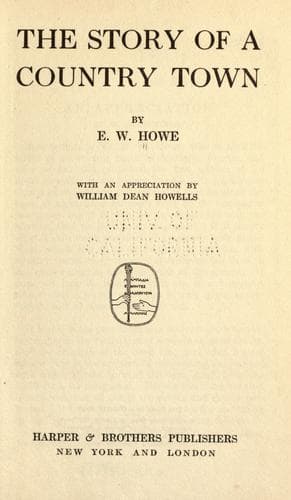
The Story of a Country TownHowe, E. W. (Edgar Watson)
General
The Story of a Country Town
Howe, E. W. (Edgar Watson)
Frontier and pioneer life -- Kansas -- Fiction
My mother was never strong, and her health seemed to be rapidly failing,
but she was perceptibly revived by the presence of Agnes. When I told
her that Agnes would now live there all the time, and never go away
again, she expressed great pleasure, and for days was not content to be
out of her company, but followed her slowly around the house as she went
about her work. We were like three children again, suddenly released
from restraint, but when we spoke in the evening of the happy years we
should spend together, my mother became thoughtful at once, and would
say no more that night.
Her step was slower than it had ever been; and she walked more feebly,
but she still kept up the lonely vigils in her own room at night, and
the light was always burning, casting its rays across the deserted
street like a pitying star. If I became restless in my bed from thinking
of her pale face, and went softly down the stairs to her door, I found
her quietly seated in the low chair, as if waiting for a step in the
street and a hand on the door. She no longer came to my room at night,
as she had done when we were alone, but she apologized for it once
because of growing weakness, and believing that she dreaded to be alone,
I sometimes lay down on her bed and slept there, but if I awoke in the
night, I found her in the old corner, with her head bowed low, and
wrapped in deep meditation.
The coming of Agnes brightened the lonely house, which had always been
cold and cheerless, as if it were very old, and were inhabited only by
very old people, and I was more content than I had been, until I
remembered that my mother was slowly dying of a broken heart. This
thought came to me whenever we were spending the evening pleasantly
together, and often I went away to hide my tears. When I talked to Agnes
about it, which I often did before and after she came there to live, I
saw by her troubled face that she shared my fears, and that she, too,
had marked the faltering steps and whitening hairs. Though we resolved
over and over again to do more for her comfort and happiness, and be
more watchful of her, she was always just the same--silent and
sorrowful, with a look in her white face of worry and sorrow. Whenever
she opened a door, or looked into a box or drawer, she seemed to find
something to remind her of her husband,--an article of wearing apparel,
a scrap of paper on which he had written,--and this she kept in her
hand, and carried about, holding it until she took her place in the low
chair for the night, where it remained the subject of her thoughts. We
both called her mother, and though we were anxious that she should
commend us, she seemed shy, as if she were in the way, and Agnes told me
that once when she put her hand lovingly on her head, and said we were
good children, she did it timidly, fearful of giving offence. She still
slept a little during the day--or, at least, she would darken her room
when no one was around, and lie down--but we never found her asleep at
Public-domain text, read in full here on John Shaqi.
Reviews
Reviews
No reviews yet
Be the first to share your thoughts on this work.
Elsewhere in the archive
Join the Discussion
Join the discussion
Sign in to leave a comment or review.
Sign InorCreate an account