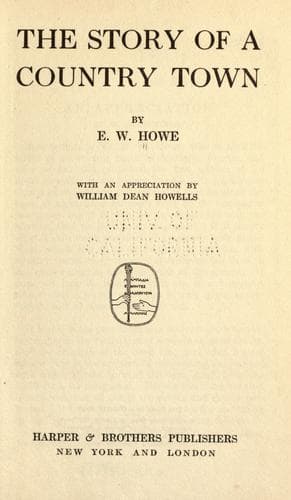
The Story of a Country TownHowe, E. W. (Edgar Watson)
General
The Story of a Country Town
Howe, E. W. (Edgar Watson)
Frontier and pioneer life -- Kansas -- Fiction
Then he did not know! He had come back, as my mother always thought he
would, at night, repentant and old, to ask forgiveness, but the one who
could forgive him was dead. I did not know what to say or do, and walked
up and down the room thinking how to answer. He followed my movements
curiously for a time, and then suddenly cowered down into his chair
again, as if to meditate over one of the old problems. While I was
wondering how to break the news to him, he turned toward me, and said:--
“I saw the lights in the front room as I came up, but hoped it was a
sign of welcome rather than of death; but I know now why you are alone.
You need not explain.”
The tears came into his eyes, but he tried to brush them away with his
rough sleeve, as though he were a child and had been warned not to cry.
I think he realized in a moment, while wondering why I was so much
agitated, that she was dead, though he had cheerfully imagined, when
approaching the house, that the lower rooms were lit up on purpose to
receive him.
“She died this morning just after midnight,” I said to him, coming over
to his side, and placing my hand on his shoulder, “but I know she always
believed you would come back. She sat in this room every night waiting,
and her last words were a blessing on your name.”
He did not look up, but I thought this assurance cheered him, though he
remained motionless so long that I think he must have reviewed his
entire life, from his boyhood in the backwoods to his manhood on the
prairie, where the forbidden processions were always passing, and from
his career in Twin Mounds through all his hard wanderings as an outcast;
a long record of discontent, sorrow, and disgrace, with nothing to
excuse it save the natural unrest with which his life had been beset
like a hell. Inexplicable and monstrous as it was, I knew it was real,
and that a devil had possession of him for whose acts he was unjustly
held accountable. A hundred times since then I have thought of John
Westlock as a worthy man driven by a fiend with whip and lash, always
sullenly protesting, but never able to resist the evil which was bred
against his nature, and against which he had struggled all his life.
I tried to decide in my own mind, as he was thinking, whether I knew him
any better, and whether I was less afraid of him now than the day he
went away, but I could not help concluding that he was the same
mysterious man he had always been.
“If you will let me, I should like to look at her,” he said, when he
looked up again, in the voice of a suppliant asking a favor of a hard
master, and so unlike him that I shuddered to think of the sorrow
necessary to make such a change in a man of his disposition.
Public-domain text, read in full here on John Shaqi.
Reviews
Reviews
No reviews yet
Be the first to share your thoughts on this work.
Elsewhere in the archive
Join the Discussion
Join the discussion
Sign in to leave a comment or review.
Sign InorCreate an account