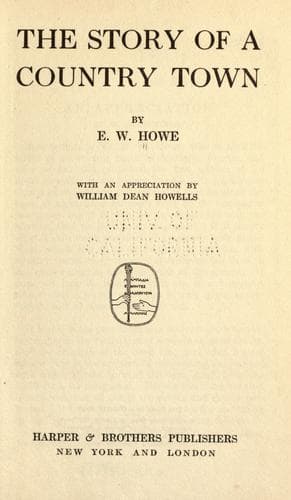
The Story of a Country TownHowe, E. W. (Edgar Watson)
General
The Story of a Country Town
Howe, E. W. (Edgar Watson)
Frontier and pioneer life -- Kansas -- Fiction
I was very anxious that the watchers should not see him; I don’t know
why, because his arrival and presence would certainly be known in all
the town in the early morning, but I knew they would only look upon him
with inward reproaches. From this I was anxious to shield him, and,
carefully going to their door, I found they slept. I then went into the
room where the coffin was, to remove the lid, which had been shut down,
from the face. I was thankful that the face wore a pleasanter smile than
I had ever seen it wear in life, and, placing the light where it fell
directly upon it, I returned to where he sat, and motioned him to
follow. He got up from his chair with difficulty, and, staggering after
me, hesitated before entering the room, but at last he followed me in
timidly, and after looking at the face for a moment, fell on his knees
before the coffin, and sobbed aloud. His grief was so great that I
feared the watchers would hear him, and waken, but, determined that he
should be left alone with the dead, I stood at the door to keep them
back should they attempt to come out. But they slept on, and when I went
into the room again, he was still on his knees, his hands covering his
face as it rested on the coffin, and I thought he was praying. I had
often bitterly denounced him in my own mind for the unhappiness he had
brought upon our house, and for the misfortunes he had founded, but I
forgave him from my heart as I saw his gray head bowed in repentance
over the dead body of the principal sufferer; nor did I regard it as a
kindness to him, but as an act of justice to an unfortunate man. I
accepted his misery as his excuse, and forgave him, as I hope that I
shall be forgiven.
When he was aroused by my touch on his shoulder, I led him gently away,
and we returned to the room we had left. Here he hugged the fire again,
as if he were still cold, and sat without speaking so long that I
thought he was trying to solve the hardest problem of his life.
“It was I who made the mistake,” he said finally, without changing his
position, and as though we had been saying that some one had made a
mistake. “She was always patient, but I was dissatisfied and restless. I
thought that if I were married to a flashy, ambitious woman, nothing
would be impossible; but I know now that her quiet patience and content
were rare jewels which I spurned and neglected. I confess to you now
that I was wrong, and that she was right.”
He seemed never to have confessed this to himself before, and repeated
it, so there could be no mistake.
Public-domain text, read in full here on John Shaqi.
Reviews
Reviews
No reviews yet
Be the first to share your thoughts on this work.
Elsewhere in the archive
Join the Discussion
Join the discussion
Sign in to leave a comment or review.
Sign InorCreate an account