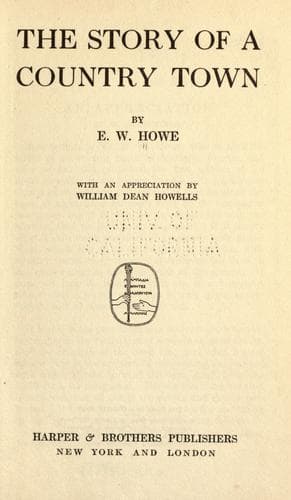
The Story of a Country TownHowe, E. W. (Edgar Watson)
General
The Story of a Country Town
Howe, E. W. (Edgar Watson)
Frontier and pioneer life -- Kansas -- Fiction
“There is but one thing to do; to notify the officers, and finish this
night’s work in jail. I have thoroughly considered the matter while you
were away, and that is my decision. When I heard that this marriage was
to take place, I resolved to do what I have done to-night, and arranged
my business for it by leasing the mill. The man who is to operate it is
my present assistant, and all the necessary arrangements have been made;
I only hope now that I shall be disposed of as soon as possible. I do
not regret what I have done, now that it is done, and the most pleasant
moment of my life was when I clutched the throat of the man who has been
relentlessly pursuing me for five years. He could not be induced to give
up his design, and I could do nothing else than murder him. I have only
lived for the past few months to guard Mateel against him, and now that
she is no longer in danger, I am ready for the worst. When I looked into
her face to-night, it startled me to see how she has failed since we
separated. I shall always feel grateful to her that she was not dressed
as a bride, but in mournful black. Always delicate, she is but a shadow
now, and the marriage of Bragg to a woman who is but a puny invalid
convinces me that he, at least, brought it about to revenge himself on
me. He brought on the quarrel; I hope he is satisfied. I am sure only
Mateel’s weakness is to blame for her part in the affair, for marriage
in her condition was mockery.”
He appeared more contented and easy than he had been since the
separation, like a man who had accomplished an object that had been his
ambition for a long time, and sat down again, quite at ease, when he saw
I was not yet ready to go, but was trying to dry my wet garments at the
fire. I even thought he felt in good spirits, for he straightened
himself in such a manner as to be comfortable in his chair, and beat a
merry tattoo with the fingers of his hand which rested on the table.
When at last I was ready to start to town with him--I had never thought
of opposing him, he seemed so satisfied with the course he had marked
out--he collected a few articles which he said might be of use to him
during his imprisonment, and, making them into a bundle, extinguished
the light, and followed me, after locking the door and handing me the
key.
“I shall never see the place again, of course, nor do I want to see it,”
he said. “I have had a hard time of it here, from first to last, and for
all my work I get nothing but a ride to jail to be locked up for murder.
A splendid fellow, I, that could work to no better purpose. I thought
once I was something of a genius, and rather a remarkable fellow, but
like all other fools I am found out. There is one satisfaction in it
all; I was not all my life finding out my mistake. I am now but
twenty-six; I have known greater fools than I am, at seventy. I am glad
there is a storm; I like to be out in it.”
Public-domain text, read in full here on John Shaqi.
Reviews
Reviews
No reviews yet
Be the first to share your thoughts on this work.
Elsewhere in the archive
Join the Discussion
Join the discussion
Sign in to leave a comment or review.
Sign InorCreate an account