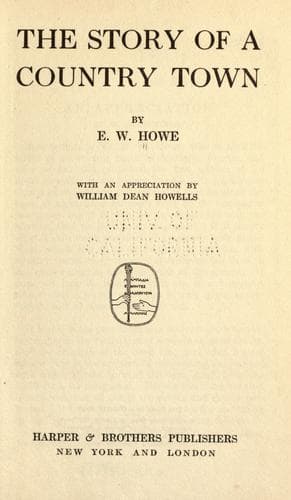
The Story of a Country TownHowe, E. W. (Edgar Watson)
General
The Story of a Country Town
Howe, E. W. (Edgar Watson)
Frontier and pioneer life -- Kansas -- Fiction
On the way he kept talking in a half-boisterous manner, though I could
detect a mournful strain through it all. Once he wondered if there was a
possibility that Bragg had only been stunned, and, stopping the horses,
wanted to go back to see. But after thinking about it awhile, he said:--
“No danger of that. He fell out of my grasp as limp as a rag. I held him
at arm’s length to represent a gibbet, and my fingers were the rope, for
the brute deserved hanging. I was determined that he should die a
dishonorable death as well as I. When he is found, there will be marks
about his throat as though he had been hanged; his tongue will protrude
from his mouth, and his eyes start from their sockets, as they say men
look who have been hanged. My only regret is that there was not a crowd
present to witness his dog’s death. But the crowd will gather around him
to-morrow, and be horrified at his appearance.”
Several times he described with pleasure the horrible tragedy in the
woods near the ford, hoarsely laughing as he told how Bragg had writhed
and struggled in his grasp, and once he asked me to feel the bunch of
muscle on the strong arm which had righted his wrong. He told how he
had skulked under the trees waiting for their approach, dodging from one
to another when he saw them in the road; how he had hidden behind a tree
until they were beside him; how Bragg had trembled in fear when he felt
his fingers about his throat; how fast and furious the vicious horse ran
crashing through the underbrush when he lashed him with a keen hickory
withe cut for the purpose, and how he almost shouted in exultation when
he had Mateel in his arms. He recited all the sickening particulars with
so much pleasure that I feared he was out of his head, and occupied
myself in mentally making notes of what he said to prove that he was not
responsible for his act. At another time he cried out impatiently:--
“Why don’t you applaud what I have done? You have not said a word all
evening, though you usually cry, ‘Brave Jo!’ when I have accomplished a
purpose, but you seem ashamed of me now.”
“Oh, Jo,” I replied, “you have done an awful thing, and while I know you
were wronged by Bragg, I shudder to think of the consequences. I cannot
approve of this act, Jo, the first one you ever did at which I could not
cry, ‘Brave Jo!’”
Public-domain text, read in full here on John Shaqi.
Reviews
Reviews
No reviews yet
Be the first to share your thoughts on this work.
Elsewhere in the archive
Join the Discussion
Join the discussion
Sign in to leave a comment or review.
Sign InorCreate an account