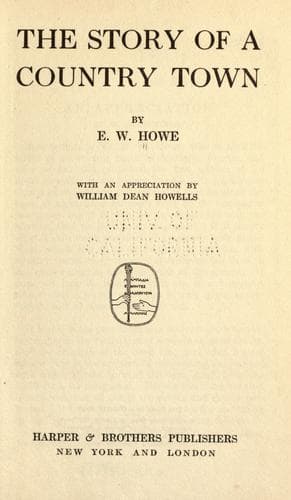
The Story of a Country TownHowe, E. W. (Edgar Watson)
General
The Story of a Country Town
Howe, E. W. (Edgar Watson)
Frontier and pioneer life -- Kansas -- Fiction
They always had their pockets full of things to give away, and I am
satisfied that they came by none of them honestly, for they were very
poor, and at home but seldom had enough even to eat. A habit of theirs
was to throw stones with great accuracy, a collection of which they
carried around in their pockets, ready for use, making long journeys to
the creek bottoms to select them. They always went home with Guinea-hens
or geese in their possession, which they said had been “given to them,”
but which they had really knocked over in the road near farmers’
houses. They could kill more squirrels and quails by throwing than
others of a similar age could by shooting, and it will be imagined that
their failings were but seldom mentioned, for they were dangerous
adversaries, though usually peaceable enough.
The teacher of this school at the time of which I now write--to be more
explicit, when I was eleven years old, for what I have already written
is a hurried retrospect covering a period of six years--was a very young
and pretty girl named Agnes Deming, certainly not over sixteen and I
doubt if that, who came from a neighborhood north of Fairview, where her
widowed mother lived with an eccentric brother, and although it was as
poor as ours, she spoke of it in such a way--not boastingly, but
tenderly and reverently--that we thought of the community of Smoky Hill
as a very superior one. Her father, of whom she talked a great deal, had
been captain of a sailing vessel, as I learned a little at a time, and
before his death they lived in a town by the sea, where his ship loaded.
Of the town, however, which was called Bradford, she had but slight
recollection, for when a very little girl she was sent away to school,
and came home only at long intervals to welcome her father, who was
often away a year at a time.
When ten years old, and after the ship had been absent a long time, she
was sent for hurriedly one day, and told on her arrival that her
father’s ship had gone down at sea; that all on board were lost, and
that they were going West to live with her uncle, an eccentric man whom
she had never seen. After a few months of preparation, during which time
their effects were converted into money, they commenced their journey to
the country in which they had since lived. When she was fourteen years
old her uncle found her a place to teach a summer school, and, giving
satisfaction in spite of her tender years, she had followed the calling
since, her second engagement being in our neighborhood. I remember how
generally it was said on her arrival that she would not do, as she was
very young, but before the summer was over she somehow convinced her
patrons that she would do, very well, as she was thoughtful and
intelligent, and competent in every way.
Public-domain text, read in full here on John Shaqi.
Reviews
Reviews
No reviews yet
Be the first to share your thoughts on this work.
Join the Discussion
Join the discussion
Sign in to leave a comment or review.
Sign InorCreate an account