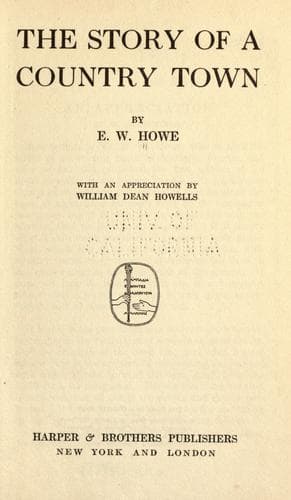
The Story of a Country TownHowe, E. W. (Edgar Watson)
General
The Story of a Country Town
Howe, E. W. (Edgar Watson)
Frontier and pioneer life -- Kansas -- Fiction
“Well, I am one,” the little man said with a show of pride. “A great
many men regard children as blessings. Now I have failed to discover any
kind of a blessing or pleasure in being called up in the middle of the
night to run for a doctor when there is croup in the house. Usually,
too, in such cases the medical man lives a great many miles away, over a
rough road. Whenever I go to bed early to make up lost sleep, or come
home particularly tired from tossing the hay or holding the plough,
either Annie, or Bennie, or Carrie, or Davie, or Effie, or Fannie, or
Georgie, or Harry, is sick, and I am compelled to go for a doctor. This
never fails if the night is very wet, the roads unusually heavy, or the
weather particularly cold. While everybody admires little children, I am
sure they would be much more popular if their teeth came more easily;
and that there would be a greater demand for them if they did not take a
hundred different diseases to which they are not exposed. I am that kind
of philosopher.”
The fire in the end of his cigar having about gone out, from holding it
in his hand and waving it at me, he revived it with a great deal of
puffing, and went on:--
“Understand me, Ned Westlock; I do not complain. I am like other men,
except that I am not a fool; and while I accept the bitter with the
sweet, I point out the bitter and refuse to call it palatable. I am at a
loss to understand, for example, why the Creator is more considerate of
pigs than He is of children; for I believe pigs cut their teeth before
birth, and seldom die except when fat from good health, and at the hands
of a butcher. Children, on the other hand”--he used his right hand to
represent the pigs, and his left to represent the children--“are never
well, and for every tooth there is an insolent doctor with a bill, to
say nothing of measles, coughs, rashes, and fevers. I have seen it
estimated that it requires three thousand eight hundred and seventy-nine
dollars and thirty-five or forty cents to raise a baby to manhood or
womanhood. A pig may be raised to maturity with a few hundred buckets of
slop, a few bushels of corn, and a wisp of hay occasionally for a bed.
What do you think of that?”
As he looked at me as though I had been stubbornly arguing the cause of
the children, I replied that the pigs had the best of it, so far,
decidedly.
“If you have never talked with a philosopher before, you may never have
had your attention called to the fact, which possibly has escaped your
own notice, that children do not appreciate good treatment, as do pigs
and other animals. The very worst thing you can do for a boy is to treat
him well. Where do you find the good boys?”
He made a pause as if expecting a reply, and I said, “I don’t know,” but
I knew at once that he was impatient that I had replied, for he wanted
to do all the talking himself.
Public-domain text, read in full here on John Shaqi.
Reviews
Reviews
No reviews yet
Be the first to share your thoughts on this work.
Elsewhere in the archive
Join the Discussion
Join the discussion
Sign in to leave a comment or review.
Sign InorCreate an account