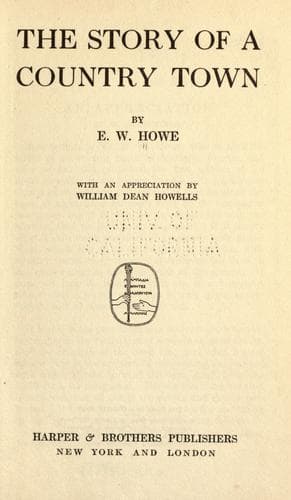
The Story of a Country TownHowe, E. W. (Edgar Watson)
General
The Story of a Country Town
Howe, E. W. (Edgar Watson)
Frontier and pioneer life -- Kansas -- Fiction
“In families where boys are always hungry and abused,” he resumed.
“Where do you find your bad boys? In families where they are treated
well, of course. A boy who has plenty to eat, and plenty to wear, and
nothing to do, is always impudent and worthless; and parents who go to
trouble and expense that their children may be happy and idle pay a big
price for a pestilence. I do not pretend to say that in practice I am
more of a philosopher than my neighbors; but it is a fact, nevertheless,
that the pig that slips into the house and litters it up is beaten with
a broomstick until he understands, when tempted on future occasions,
that the practice is dangerous. If the pigs get on the porch, and you
open the door suddenly, they run away in great haste, having been taught
by harsh means that they are not expected there; and if we would teach
children in the same way, we should have more comfort with them. But
practically we regard the training of pigs as more important than the
training of children, and suffer much discomfort in consequence. I
recognize certain inexorable masters, and obey them to avoid
uncomfortable consequences; and a child must have a master, or it will
become disagreeable and annoying.”
He stopped to listen to the noise made by his family up stairs. It was
very uproarious, and I thought he was regretting that his philosophy had
not been made to bear some practical fruit.
“If you were a young man,” he continued, coming out of a brown study,
“and had driven from Fairview to ask my advice on this question, I
should advise you thus: ‘Sir, if you covet the society of little
children, hire them to play at your house until you are tired; for then
you can send them away, and enjoy the quiet following their absence. You
will find that pleasant enough, but if you have a house full of your
own, that alters the case; for like the deserving poor, they then are
always with you--in sickness as well as in health, and when they are
disagreeable as well as when they are not.’ That would be my candid
advice; you may accept it, or let it alone, as you choose.”
He waved the hand at me which he had previously used to represent the
pigs, as though I had been asking him to counsel me on the subject, and
as if he were impatient that I did not accept his advice at once. But
recollecting himself, he took a delicate knife from his pocket, and
after profuse apologies for his ill-manners, proceeded to pare his
finger nails, looking occasionally at me as if doubting my ability to
understand his philosophy, for I had scarcely said a word in reply to
it.
“I understand your father is a singer,” he said, after his fingers were
mentally pronounced satisfactory.
I replied with a show of pride that he had the finest voice ever heard
in Fairview church, and that he was famous for it.
Public-domain text, read in full here on John Shaqi.
Reviews
Reviews
No reviews yet
Be the first to share your thoughts on this work.
Elsewhere in the archive
Join the Discussion
Join the discussion
Sign in to leave a comment or review.
Sign InorCreate an account