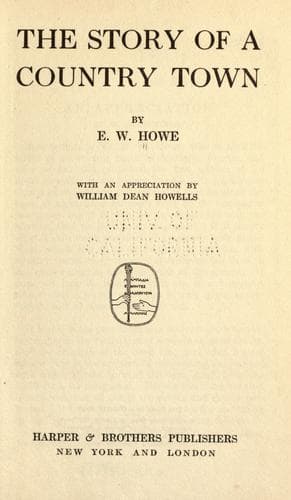
The Story of a Country TownHowe, E. W. (Edgar Watson)
General
The Story of a Country Town
Howe, E. W. (Edgar Watson)
Frontier and pioneer life -- Kansas -- Fiction
“We have many of the same kind of men in Smoky Hill. It affords me
pleasure to assure you that I am unpopular with them, and they take
great comfort in the belief that I am likely to die in a year or two of
consumption. But I have already had the satisfaction of attending the
funerals of five men who predicted that I was not long for the world; I
expect to help bury the rest of them at intervals in the future. While I
get a little stronger every year, by care and common sense, they get a
little weaker, by carelessness and ignorance, and finally they are
buried, with L. Biggs, Esq., the consumptive, looking contentedly on.
The trouble with these men is that they eat everything coming in their
way, like pigs, lacking observation to teach them that a greater number
of people die of over-feeding than die of over-drinking or over-working.
The last Smoky Hill glutton that died was the Most Worthy Chief of a
temperance society, and he was always quarreling with his wife because
she didn’t have pie for breakfast. For my part, I detest pie.”
I was about to say that while I agreed with him in everything else, I
should be compelled to make an exception in the pie particular; but he
did not give me opportunity, for he proceeded:--
“In my visits to the homes of cultured but unwise people, I am
frequently tempted to do violence to my stomach by eating late at night,
but recollecting the fate of the Smoky Hill men, I respectfully decline.
When I am offered cake, and nightmare in other forms, I do not greedily
accept and devour everything set before me, but instead I say, ‘If you
have cold oatmeal mush, or a bit of graham bread, I will refresh myself
with that, but no cake, I thank you, although the assortment is fine,
and reflects great credit on the lady of the house.’ Thus I preserve my
health, and prove my philosophy. But no doubt I am wearying you; I will
show you to bed.”
He did not ask me whether I was tired of his company, but picked up the
light as though he could decide questions for boys without their
assistance, and leading the way up stairs, I meekly followed. Opening a
door after reaching the upper floor, he gave me the light, said good
night, and went down again, as though he had not had enough of his own
company, and would sit up a while longer.
Public-domain text, read in full here on John Shaqi.
Reviews
Reviews
No reviews yet
Be the first to share your thoughts on this work.
Elsewhere in the archive
Join the Discussion
Join the discussion
Sign in to leave a comment or review.
Sign InorCreate an account