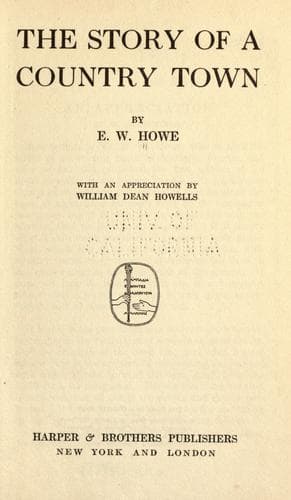
The Story of a Country TownHowe, E. W. (Edgar Watson)
General
The Story of a Country Town
Howe, E. W. (Edgar Watson)
Frontier and pioneer life -- Kansas -- Fiction
There were two comfortable beds in the room to which Mr. Biggs had shown
me, and Big Adam occupied one of them already, sound asleep. His clothes
were piled up in a heap by the side of it, with the Λ-shaped hat on top,
ready to go on the first thing in the morning. He mumbled occasionally
in his sleep, and I thought he was saying he did the best he could, and
that it wasn’t pleasant to be “jawed at,” which made me think again of
the terrible old woman with the parchment face, the little head, the
little body, and the little knot of hair on the back of her head. I felt
like kneeling down by my bed and praying that the queer woman might not
have a habit of walking through the house at night, accompanied by the
kitchen butcher-knife freshly sharpened at the grindstone, for there was
no lock on the door. But speedily occupying the other bed, and putting
out the light, I had hardly begun thinking of the curious family before
I was sound asleep.
CHAPTER IX.
THE CHARITY OF SILENCE.
When I went down to breakfast the next morning, I found Agnes waiting
for me, and the meal ready; and as was the case the night before, she
presided at the table without sitting down. I ate alone, and in silence,
as it was explained that Mr. Biggs was not yet up, though it was late,
and Agnes did not seem to be in a mood for talking. The circumstance
that other members of the family kept out of the room made me think that
I was regarded in the house as a sort of a machine likely to explode and
hurt somebody, and could be approached only by those who knew where the
safety valve was which blew me off; for I supposed Mrs. Biggs and Mrs.
Deming to be very aristocratic people, who could not tolerate a
country-bred boy. Therefore I did not feel in very good humor myself,
thinking that Agnes was ashamed to exhibit me to her friends. Going out
to the stables in lazy preparation for returning home, I found Big Adam
pitching hay, as I had left him the day before.
“Well, young Westlock, how are you now?” he inquired, leaning on his
fork.
I returned his greeting, and said I would hitch up when he had time to
help me.
“You needn’t be in a hurry about it,” he said, returning to his work.
“If I were you I would manage to get home just at dark, for then you’ll
have nothing to do during the day. If you get back too early the
preacher may find something for you to do.”
There was a good deal of truth in this, and I thanked him for the
suggestion.
“I know something about hired help and boys on a farm. I have had a ripe
experience in the service of Biggs. I thought he would talk you to death
last night; it’s a terrible death to die. What did he say?”
I repeated portions of the conversation, and gave particular stress to
what he had said concerning his and Big Adam’s doing the work of half a
dozen men.
Public-domain text, read in full here on John Shaqi.
Reviews
Reviews
No reviews yet
Be the first to share your thoughts on this work.
Elsewhere in the archive
Join the Discussion
Join the discussion
Sign in to leave a comment or review.
Sign InorCreate an account