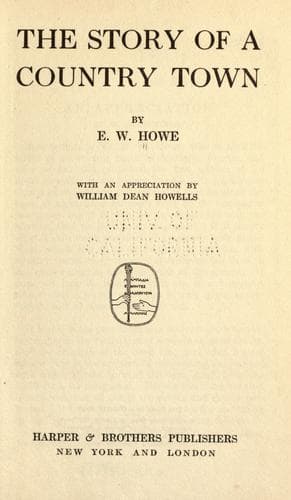
The Story of a Country TownHowe, E. W. (Edgar Watson)
General
The Story of a Country Town
Howe, E. W. (Edgar Watson)
Frontier and pioneer life -- Kansas -- Fiction
“But it is only for three or four years, Ned,” as if we had been talking
instead of thinking of the separation, “and at the end of that time I
may be able to make you my assistant, or, better still, my partner. We
have had a very wretched time of it in the past, but there may be a
great deal of pleasure in store for us in the future. If we work as hard
as we expect, I believe everything will come out right yet. They say you
are old of your age. I am not old of my age; on the other hand I am very
dull: but I shall be a man then, and in any event one need not be old to
be useful. People here think differently, but it is because the
community is slow and ignorant. Here the man who owns a piece of land
and a team is supposed to have accomplished all that it is possible for
a man to accomplish; but Barker told me once that there are men who make
a Fairview fortune in a day. I don’t want to be like the people here,
for none of them are contented or happy; but I intend to be like the
people who I am certain live in other countries. I cannot believe but
that there is a better way to live than that accepted at Fairview, and
that somewhere--I don’t know where, for I have never travelled--happy
homes may be found, and contented people, where parents love their
children, and where people love their homes. Therefore I shall begin
differently, and work harder, and to more purpose, than the people here
have done, to the end that I may be a different man.”
Heaven help you, Jo, in that. There never was a happy man in Fairview,
and I hoped with all my heart that Jo might become one, as he deserved.
“I have always been lonely and friendless,” he went on. “They never
wanted me at home; your father never seemed satisfied with me here, and,
excepting you, I have never had a friend in my life. I care nothing for
my family; I fear it is sad depravity, but I cannot help it. They have
never treated me well, and care nothing for me, and I cannot feel kindly
toward them, for no one can love without a reason. You do not fall in
love with the woman that wounds you, but you do fall in love with the
woman that is kind to you. I think a great deal of you, but you gave me
reason for it by thinking a great deal of me. I never knew until I
thought of going away how much I did think of you.”
He talked so pitifully of the neglect to which he had always been
subject, and I knew so well it was true, that I could only reply through
my tears that he was my best friend, and that I thought more of him than
any one else in the world.
Public-domain text, read in full here on John Shaqi.
Reviews
Reviews
No reviews yet
Be the first to share your thoughts on this work.
Elsewhere in the archive
Join the Discussion
Join the discussion
Sign in to leave a comment or review.
Sign InorCreate an account