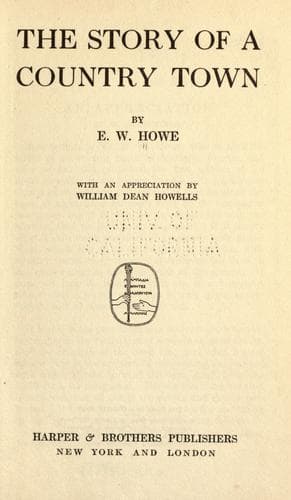
The Story of a Country TownHowe, E. W. (Edgar Watson)
General
The Story of a Country Town
Howe, E. W. (Edgar Watson)
Frontier and pioneer life -- Kansas -- Fiction
“While they all occasionally have kind words for others, they never have
a word of encouragement for me, but I am glad that I did not deserve it.
I should hate to feel that I deserve all the unkindness I have received
here, and that I was as idle and unworthy as they seem to think me; but
I never did, and I hope you honestly think so. You are the only one
among them who was fair and just, and after I have gone away I shall
only have you to remember pleasantly. I am glad that I am going to a
place at last where I shall be welcome and useful.”
I thought that afternoon that all of them were unjust to Jo and steadily
refused to give him the credit he deserved; I think so now, a great many
years after, with a maturer mind and greater experience.
“We have been very ignorant here, you and I.” It was very disgraceful,
but very true. “Your father is wise enough, but as he takes no pains to
impart it to others, we have had little benefit of his wisdom. For the
next two years I shall live with a man who is educated, and who will
willingly teach me, and I intend to tax his patience with my studies.
Barker is not only learned, but he is courteous, and I can learn
something of polite manners. He bows like a king; only a very few men
are able to make a really good bow. I asked him once where he learned
it, but he only laughed, and said everyone ought to be polite without
learning it anywhere. It made me ashamed, for politeness never came
natural with me. Perhaps I am so awkward because I do not come of a good
family.”
Certainly his father and mother were not polite to each other, or to
their son.
“I have made many terrible mistakes from not knowing any better, and
they will humiliate me all my life. Once I went with your mother to call
at the new minister’s--this is in the strictest confidence, and never to
be repeated--and I did a thing so dreadful that I am blushing now in
thinking of it. I wore a little cap (I have since burned it), and
although I know now it was hideously ugly, I thought then that it made
me very handsome. I bought it of a boy who had lived in town, and I had
seen town boys wear them. So I shuffled into their parlor wearing your
father’s boots, with a pair of his pantaloons tucked into their tops,
and the cap on my head. The Shepherds are very well-bred people, and
after I had stumbled across the room, and fallen into a chair all in a
heap, Mateel--how pretty she was that night, and how pretty she always
is!--came over to me, and asked to lay away my cap. I thought it very
amiable in me not to trouble her, so I refused to give it up. In fact, I
said:--
“‘NO, I THANK YOU; I AM VERY COMFORTABLE AS I AM!’
“And I sat the entire evening through with that cap on my head. Nobody
had ever told me to remove my cap in the presence of ladies, and being
of a poor family, I did not know it without being told. I know better
now, for Barker laughed at me, and explained why it was wrong.”
Public-domain text, read in full here on John Shaqi.
Reviews
Reviews
No reviews yet
Be the first to share your thoughts on this work.
Elsewhere in the archive
Join the Discussion
Join the discussion
Sign in to leave a comment or review.
Sign InorCreate an account