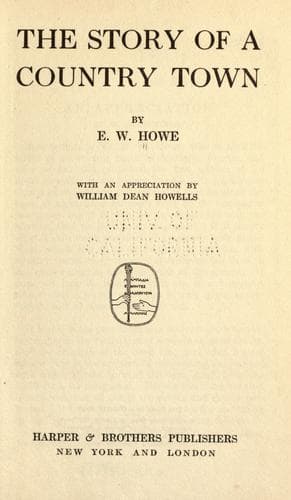
The Story of a Country TownHowe, E. W. (Edgar Watson)
General
The Story of a Country Town
Howe, E. W. (Edgar Watson)
Frontier and pioneer life -- Kansas -- Fiction
When we went into the house again, my father was sitting in his
accustomed place, thinking. He had not changed his position since we
went out of the room, an hour or two before, and I think he regretted he
could not go out into the fields and lose his thoughts in working. He
looked up when we came in, and addressing himself to Jo, said:--
“Are you glad to go?”
“Yes, sir,” Jo promptly responded.
This did not seem to surprise him, and he kept on thinking, as though he
might have known it without asking.
“I have no doubt you think I have been a hard master,” my father said.
“I have been, but because I believed it was best to teach boys to work.
Before you reach my age, you will know I was right, and that the course
I have pursued with you was the best one. But to show you that I am
anxious for your success, I offer to help you start the mill at The
Ford, if you apply yourself at Barker’s and give me reason to believe
that you are worthy and capable. Whatever else you may think of me, you
know I keep my word in everything. Bear this in mind during the next two
years.”
When he began thinking again, I thought it was that although he always
did that which was for the best, he was blamed for it, and hated.
“I have no advice to give you, because you would take nothing kindly
from me, and because I seldom give it to anyone. Every man must advise
himself, after he is convinced what course he had better pursue. The
world is full of people giving good advice to others, but I have thought
we should all be better off if we would advise ourselves more, and
others less. If I could take the good advice I am capable of giving, I
should have no occasion to accept it from others. The same is true in
your case; advise yourself, and see that your advice is good. I believe
you will succeed over there, and I earnestly hope you will. No more need
be said on the subject.”
When he began his thinking again, I thought it was to wonder why Jo
should not feel grateful to him now instead of in the future (he was
sure he would then), after he was dead, and in need of no evidence that
the course he had pursued was right.
* * * * *
That night I resolved to remain awake to see if my mother came to me in
my room. She did not disappoint me, and, coming in quietly, sat down on
the foot of the bed, where she remained in deep study a long while. I
could not see her face, but I was certain it was thoughtful and sad, and
that she felt ill at ease, and wretched. The moon was shining outside,
and she pulled aside the curtain to look at us. At last she got up, and
bending over the bed kissed me tenderly. I threw my arms about her neck,
and said: “Mother!”
Public-domain text, read in full here on John Shaqi.
Reviews
Reviews
No reviews yet
Be the first to share your thoughts on this work.
Elsewhere in the archive
Join the Discussion
Join the discussion
Sign in to leave a comment or review.
Sign InorCreate an account