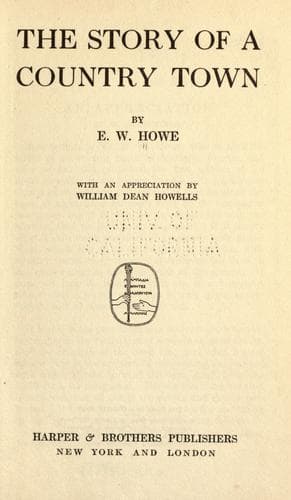
The Story of a Country TownHowe, E. W. (Edgar Watson)
General
The Story of a Country Town
Howe, E. W. (Edgar Watson)
Frontier and pioneer life -- Kansas -- Fiction
She fell on her knees beside the bed, and sobbed in such distress that
my father heard her, and came in hurriedly from the other room to
inquire what was the matter. But only her sobbing answered him, and
speaking to her tenderly, as if divining what had affected her, he led
her away, with his arm around her.
“Your father has been thinking again,” Jo said, as the door closed upon
them. “I was awake, too. Ned, never keep anything from me again.”
CHAPTER XI.
WITH REFERENCE TO A MAN WHO WAS SENT WEST TO GROW UP WITH THE COUNTRY,
OR GET KILLED.
A few months after the Shepherds came to Fairview, and after they had
become fairly settled in their new home (they lived beyond Erring’s
Ford, and on the other edge of the timber which began there), a fellow
arrived who was thoroughly disliked from the moment of his appearance,
because he had an insolent manner, an insolent walk, and was insolent in
everything he did, to say nothing of his flashy dress and a general air
of impudence. His name was Clinton Bragg, and as he appeared there in
company with the Shepherds, it was soon understood that in the country
from which they came their families had been intimate and friends. I
think he only consented to visit Fairview church on the Sunday of his
first appearance, as a geologist consents to enter a dirty pit in the
earth, for the satisfaction of seeing curious specimens and formations,
and he regarded the people he saw, whom he looked at with a cool stare,
as a herd of peculiar beasts or a drove of something.
Mr. Shepherd had applied himself with great industry to
agriculture--although it was not expected of him, as his salary was
sufficient for his support--but a member of the congregation had given
him the free use of a piece of land, and he devoted certain hours of
each day to cultivating it. His appetite and strength (both of which had
deserted him years before) had returned from this exercise, and he
progressed so well that it was known that after he had remained at
Fairview as long as the rules of the church allowed, he would give up
preaching altogether and follow agriculture instead.
Public-domain text, read in full here on John Shaqi.
Reviews
Reviews
No reviews yet
Be the first to share your thoughts on this work.
Elsewhere in the archive
Join the Discussion
Join the discussion
Sign in to leave a comment or review.
Sign InorCreate an account