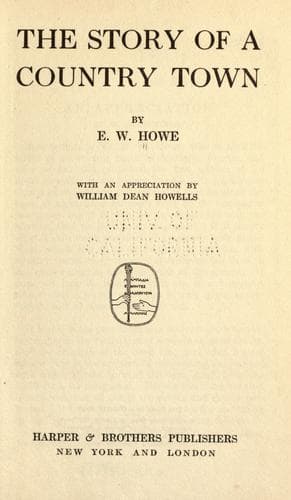
The Story of a Country TownHowe, E. W. (Edgar Watson)
General
The Story of a Country Town
Howe, E. W. (Edgar Watson)
Frontier and pioneer life -- Kansas -- Fiction
“I take it that people do not come west for society, but rather because
there are more acres than people in this direction,” Barker said. “I
have been told that it is possible to get too much of society, and that
after it quiet is appreciated. To this class Fairview will prove a
satisfactory place. My nearest neighbor lives two miles away; I
shouldn’t care if he lived ten. He is an ignorant fellow, who chops wood
for a living; and he is very considerate, for he never comes to see me.
I think I never spoke to my neighbor except to ask him how much was my
debt. We get along very well. Who is the young man at the window?”
noticing Bragg, who had changed his position and was looking at the sky.
I replied that he was a friend of Mr. Shepherd’s, and that he had only
arrived a few days before.
“He looks as though he was in jail for murder, and meditating an escape
in order to commit the same offence with greater atrocity. What is the
matter with him?”
I was afraid that this might offend Mateel, but after seeing that Bragg
had not heard it she laughed over it, as did the rest of us. She added,
however, that he was in excellent health, and that he was more moody
than sullen, and could be very agreeable when he wanted to be.
“I judge he has had too much of society, and enjoys the quiet of
Fairview. He looks pleasant.”
I will swear that Bragg’s face was the most unpleasant and disagreeable
at that moment I had ever seen.
“He should visit the mill for quiet. We have no noise there except the
roar of the water and the rumble of the wheels, and we have grown so
accustomed to these that it would not be quiet without them. I hope he
will like the country.”
At this moment my father and Mr. Shepherd came around from the orchard,
and Barker bowed low on being presented. I thought Mr. Shepherd
regretted he had not known Barker was so polite, as he could have shown
something in that line himself; but they got on very well together, and
were soon talking like old friends. We sat there for an hour or more,
listening to their easy and cultured conversation, and it occurred to
me, with renewed force, that Fairview was getting out of its old ways.
Mr. Shepherd promised to visit him, the invitation having been extended,
and my mother and the minister’s wife coming out later the party was so
agreeable that I wondered we could not have more of it instead of the
discontent which usually oppressed us. Hearing our peals of laughter, I
hoped Bragg regretted he had not been in better humor and joined the
company; but he never looked that way, and pretended to be occupied with
himself.
“You have never been inside of Fairview church, Damon,” my father said
to him, quite familiarly, late in the afternoon; “won’t you come
to-night?”
“I will walk on with Ned,” Barker replied, good-naturedly, and rising,
“and think of it after I reach the cross roads; I see it is almost time
to start.”
Public-domain text, read in full here on John Shaqi.
Reviews
Reviews
No reviews yet
Be the first to share your thoughts on this work.
Elsewhere in the archive
Join the Discussion
Join the discussion
Sign in to leave a comment or review.
Sign InorCreate an account