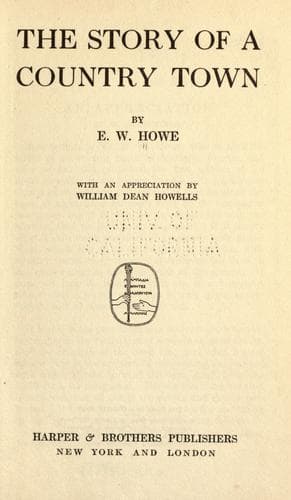
The Story of a Country TownHowe, E. W. (Edgar Watson)
General
The Story of a Country Town
Howe, E. W. (Edgar Watson)
Frontier and pioneer life -- Kansas -- Fiction
After taking his leave of all of them in a courteous way, I walked with
him along the path leading across the field, my father excusing me from
further attendance for that purpose.
We proceeded quite leisurely, as there was no hurry, and after we had
walked a considerable distance my companion said:--
“A very pretty girl, and intelligent enough, but weak. She could be
coaxed into anything. They say that is true of all light-haired women.”
I did not know whether he meant Agnes or Mateel, so I inquired, “Who?”
“The one you call Mateel. She has a pretty face, but were I inclined to
criticise such a delightful girl I should say she lacks decision. The
other one hardly spoke to me. What is it they call her?”
“Agnes.”
“The school-teacher, I believe. She is very much of a woman, though
evidently young. I admire her more than the other one. Do her people
live here?”
“No; in Smoky Hill.”
“Very respectable, I have no doubt. I should like to know her father,
and congratulate him.”
“Her father is dead,” I answered.
“Oh! Dead.”
He walked on in silence for a considerable distance.
“An orphan. It’s a pity.”
I narrated what little I could tell of the family after the promise to
Agnes, though I longed to tell him of her mother; but it seemed to bore
him, and he dismissed the subject after I had concluded in a rhapsody
for the gentle and patient Agnes.
By this time we had reached the cross-road, leading in one direction to
the church and in the other toward his home. He stopped here, and
said:--
“I will not go to the church to-night, if you will be good enough to
present my excuse to your father. It is a long road home, and I must
walk it. You know that you are always welcome at the mill, and that Jo
is anxious to see you. Good-night.”
He turned abruptly on his heel, and, walking away, his form was soon
lost in the rapidly approaching darkness.
When I arrived at the church I found the others all there, and was
surprised to find Bragg in better humor, as if the darkness suited his
disposition better. He was walking about quite contentedly, looking
curiously (and impudently) at the knots of people collected in the yard,
and listening to what they were saying. At times I thought he would
speak to them, and his eyes, dull and heavy all day, were now as bright
and active as a ferret’s, and I thought he could penetrate the darkness
with them, for while the services were in progress he kept walking
about, closely regarding everything, as though it were broad daylight.
When the people came out, he met the Shepherds at the door, and went
down the walk with Mateel on his arm, and when they drove away I thought
I heard him talking quite good-naturedly. Had the fellow’s spirits
deserted him at the approach of day, and come back with the darkness?
CHAPTER XII.
LOVE’S YOUNG DREAM.
Two months had passed since Jo had gone to live at the mill, and on a
Saturday afternoon it was arranged that I should visit him, and remain
until Monday.
Public-domain text, read in full here on John Shaqi.
Reviews
Reviews
No reviews yet
Be the first to share your thoughts on this work.
Elsewhere in the archive
Join the Discussion
Join the discussion
Sign in to leave a comment or review.
Sign InorCreate an account