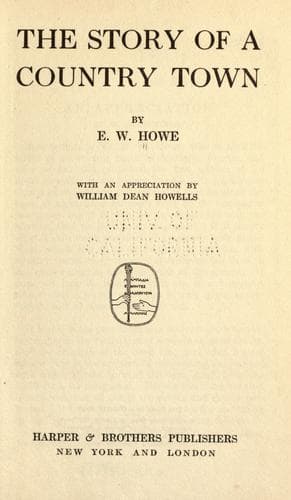
The Story of a Country TownHowe, E. W. (Edgar Watson)
General
The Story of a Country Town
Howe, E. W. (Edgar Watson)
Frontier and pioneer life -- Kansas -- Fiction
My father was at the country town a great deal of late, and the farm was
being neglected in the hands of the renter and his two sons, who I often
thought were shiftless men, or they would have owned a farm of their
own, for land was cheap and plentiful. When he returned from these
visits to Twin Mounds, he was more thoughtful than ever, and after
making long rows of figures in his private book, and casting them up, he
pondered over the result, as if he had added another problem to the
number he was always studying over.
I did not get started until late, and as I rode away my father came out
to say that, unless I hurried, night would overtake me in the woods, and
as it was the first time in his life he had paid me so much attention, I
thought, as I rode along, that Fairview was certainly progressing, and
that the old order of things was passing away.
The road which I travelled led through the fields past Theodore Meek’s,
and thence through the woods, and, as I went along leisurely, when I was
half way it began to grow dark. This did not alarm me, however, as I was
well acquainted with the way, and there was no prospect of getting lost.
As I came out upon the ridge dividing the waters of Bull River and Big
Creek, where there was an opening, and the trees gave way to
underbrush, I saw a man ahead of me riding on horseback, as I was.
Thinking he was going my way, and would keep me company, I hurried on to
come up with him, but he turned out of the road when I approached him,
and rode off to the left. Although it was almost dark, I recognized the
horseman as Clinton Bragg, and the direction he took indicated that he
was on his way to visit the Shepherds. Coming up to the place where he
had turned off, I saw that there was no road, and had a mind to halloo
to him, thinking he was not familiar with the country, and might have
lost his way, but before I could put that intention into execution, he
urged his horse into a gallop, and passed rapidly along the deep shadow
skirting the other side of the clearing. I remembered then that the
fellow, like an owl, was more himself after dark than during the day,
and, supposing that he had concluded to ride through the timber and
darkness to save distance, I thought no more of him, except to wish that
he would have trouble.
When I arrived at the mill it was long after dark, and, wishing to
surprise Jo, I put the horse away alone, as I was familiar with the
stables from frequent visits. Seeing no light in the house, I supposed
he was at the mill, and went in there, although it was dark, and I
should have thought it deserted but for the circumstance that all the
machinery was in operation. Hearing some one in the basement, I sat down
until he had finished and started up the stairs, when I saw it was Jo,
carrying a lantern.
“And so you have come at last,” he said, hanging the lantern on his arm,
and taking both my hands in his. “I had almost come to believe that you
had forgotten me.”
Public-domain text, read in full here on John Shaqi.
Reviews
Reviews
No reviews yet
Be the first to share your thoughts on this work.
Elsewhere in the archive
Join the Discussion
Join the discussion
Sign in to leave a comment or review.
Sign InorCreate an account