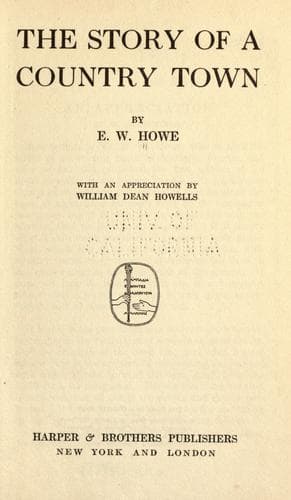
The Story of a Country TownHowe, E. W. (Edgar Watson)
General
The Story of a Country Town
Howe, E. W. (Edgar Watson)
Frontier and pioneer life -- Kansas -- Fiction
“There seems to be no doubt that I am madly in love,” he repeated again,
looking at the flame of his lantern, as though it were likely to give an
opinion as to whether he was or not. “I don’t know whether to regard it
as a serious circumstance or a pleasant one. They say that one’s first
love does not amount to anything, and that one soon forgets it. It will
not be that way with me, I am certain. I should be ashamed to offer my
affections to another girl after having loved Mateel as madly as I do
now, and I should feel that I was offering a poor return for the love I
should expect of a wife. I am convinced that a man who has loved but
once makes a better husband than one who is in doubt as to whether he
ever loved at all. I would as soon marry a widow with children as a
woman who has been engaged, and permitted the familiarities which are
common under such circumstances. If there is anything in love at all, it
is wrong to break an engagement. A man or woman who is so uncertain in
matters of the heart as to contract a new fancy four or five times a
year, is likely to be mistaken at last. I am not acquainted with many
people who are happily married, but I am convinced that plenty of them
may be found in looking the world over, and inquiry will no doubt reveal
the fact that they were never in love but once. If I should marry, it
would seriously affect my happiness to know that another man--I despise
a man, anyhow--had caressed and fondled my wife as an accepted lover. I
wouldn’t live in the same country with him, and I should be forever
unhappy for fear that she loved him the best. It would be a circumstance
very much in favor of a happy married life for a man to know that his
wife had never seen anyone else she would marry; to know that her lips
had touched only his, and that she was innocent as well as virtuous.”
I did not know much about such matters, but I thought Jo expected a
great deal; perhaps too much. But he had grown so serious that I knew he
was deeply concerned, and though I tried to change the subject, and talk
about the mill, he answered me in such a way as to indicate that he
would talk of nothing but Mateel that night. He was uneasy and worried
in his manner, too, although I could not understand why, unless it was
regret that he had been raised so poorly, and that he was only given
opportunity to learn at seventeen; for I knew that in his affair with
Mateel he had every reason to feel satisfied, except that he was so
young and poor as to render thoughts of his marrying her almost
ridiculous. It may have been that a knowledge of the possibilities of
his future made him chafe and fret that he was compelled, from no fault
of his own, to begin life so late, and that he feared failure under such
circumstances, although success would have been certain under
circumstances more favorable.
Public-domain text, read in full here on John Shaqi.
Reviews
Reviews
No reviews yet
Be the first to share your thoughts on this work.
Elsewhere in the archive
Join the Discussion
Join the discussion
Sign in to leave a comment or review.
Sign InorCreate an account