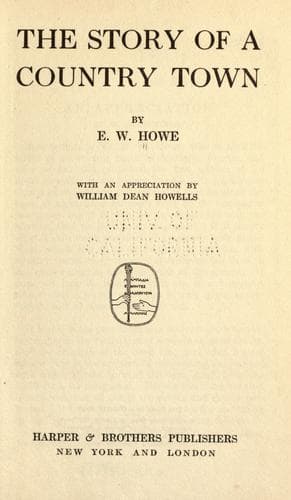
The Story of a Country TownHowe, E. W. (Edgar Watson)
General
The Story of a Country Town
Howe, E. W. (Edgar Watson)
Frontier and pioneer life -- Kansas -- Fiction
As if the thought were disagreeable, he picked up the lantern abruptly,
and went down under the mill, leaving me in the dark, and he remained so
long that at last I followed. I found him leaning against a heavy
timber, looking at the flame in his lantern again, as though it could
enlighten him if it would on certain matters of which he was anxious to
know more.
“You are becoming as great a thinker as father, Jo,” I said, touching
him on the shoulder, for he had been so occupied with his thoughts that
he had not noticed my approach. “You used to dislike him very much for
that.”
Recollecting himself, he pretended that he had come down to look at
something, and after seeing that it was all right, we went up again.
“If I was thinking,” he said good-naturedly, “it was that I had never
thought of loving until Mateel came in my way. The possibility that some
day I should marry was so remote that I never considered it, and when
you came down there just now, I was hoping that if ever I should marry
Mateel--I don’t suppose I ever shall; it was only a fancy, and there is
no harm in telling it--she would confess to me that thoughts of loving
and marrying never came to her until she met me, as I intend to confess
to her, and it will be God’s holy truth. I have never even divided my
poor affection among my relatives; you have had it all, but I don’t
think Mateel would object to that.”
Although he had only been there a short time, I thought Jo had grown to
be a man since I had seen him last. He looked larger, and older, and
acted and talked more like one than he did two months before, when he
was a boy.
“I can understand why you love me,” he said, “because I have tried to
win your regard, and we have been friends all our lives, but if Mateel
cares for me, it is because there is more to me than Fairview has ever
given me credit for. If that is not the case, then my ambition is
hopeless, and if I have been thinking, it is about that. It is pleasant
for me to know that, ignorant and rough as I am, intelligent people can
admire me at all, for I am improving very rapidly, and in time I can
hope to become worthy of the friendship of very good people. I am
surprised to think how ignorant I was a month ago; I shall be in still
greater wonder six months hence to realize how foolish I was when you
first came to see me at the mill. I have no other hope for the future
than that I can learn something every day, for if I live a long time I
can hope to know something at last. It is not a great brain that can be
exhausted at thirty, or even forty, and I expect to study very hard from
now on, that I may catch up with others of equal capacity who began
under more fortunate circumstances. I believe the day is coming when
Fairview will be peopled with the kind of men and women I am acquainted
with in my fancy; and when they arrive I am ambitious to be able to
associate with them without the restraint of stupidity and ignorance.”
Public-domain text, read in full here on John Shaqi.
Reviews
Reviews
No reviews yet
Be the first to share your thoughts on this work.
Elsewhere in the archive
Join the Discussion
Join the discussion
Sign in to leave a comment or review.
Sign InorCreate an account