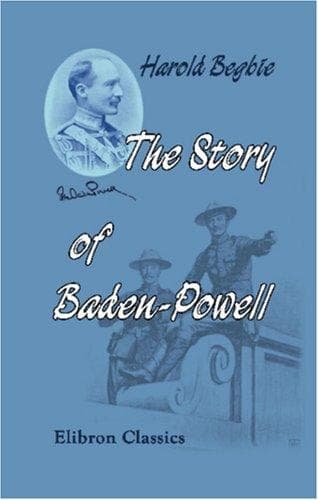
The Story of Baden-Powell: 'The Wolf That Never Sleeps'Begbie, Harold
History
The Story of Baden-Powell: 'The Wolf That Never Sleeps'
Begbie, Harold
Baden-Powell of Gilwell, Robert Stephenson Smyth Baden-Powell, Baron, 1857-1941
I have in my possession a copy of Mr. Russell's monograph on Mr.
Gladstone, which had fallen into the hands of a grand old Tory parson.
The margins of those pages bristle with the vehement annotations of my
old friend. Against the statement that Mr. Gladstone had "a nature
completely unspoilt by success and prominence and praise," there is a
vigorous "OH!" Where it is recorded how in 1874 Mr. Gladstone promised
to repeal the income-tax, I find a pencil line and the contemptuous
comment, "A bribe for power!" Mr. Forster's resignation of office in
1882 is hailed with a joyful "Bravo, Forster!" and so on throughout
Mr. Russell's interesting book. But on the last page of all there are
three pencil lines marking a sentence, and by the side of the lines
the concession, "Yes--true." The sentence is this: "But the noblest
natures are those which are seen at their best in the close communion
of the home."
CHAPTER IV
CARTHUSIAN
A gentleman once wrote to the late headmaster of Charterhouse, Dr.
William Haig-Brown, saying that he wished to have his son "interred"
at that school. The headmaster wrote back immediately saying he would
be glad to "undertake" the boy. The same headmaster being shown over a
model farm remarked of the ornamental piggery, built after the manner
of a Chinese Pagoda, that if there was Pagoda outside there was
certainly pig odour inside.
Such a man as this is sure to have been impressed by the personality
of Master Ste, who, in 1870, came to him in the old Charterhouse, that
hoary, venerable pile which seems to shrink into itself, as if to shut
out the unpoetic and modern atmosphere of Smithfield Meat Market.
B.-P. went to Charterhouse as a gown boy, nominated by the Duke of
Marlborough, and owing to the ease with which his infant studies had
been conducted, was obliged to enter by a low form. But he had, as we
have already said, an enquiring mind. He had also a clear brain, all
the better for not having been crammed in childhood; and, therefore,
strong in body, full of health and good spirits, and just as keen to
get knowledge as to get a rare bird's egg, he began his school-days
with everything in his favour. The result was that 1874 found him in
the sixth, and one of the brilliant boys of his time.
Public-domain text, read in full here on John Shaqi.
Reviews
Reviews
No reviews yet
Be the first to share your thoughts on this work.
Join the Discussion
Join the discussion
Sign in to leave a comment or review.
Sign InorCreate an account