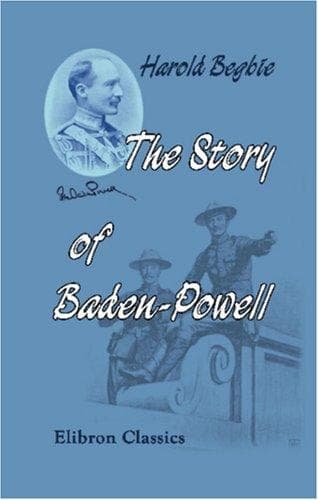
The Story of Baden-Powell: 'The Wolf That Never Sleeps'Begbie, Harold
History
The Story of Baden-Powell: 'The Wolf That Never Sleeps'
Begbie, Harold
Baden-Powell of Gilwell, Robert Stephenson Smyth Baden-Powell, Baron, 1857-1941
Baden-Powell became popular with his brother-officers directly he
joined. It was his freshness, his overflowing good spirits, his hearty
and unmistakable enjoyment of life, that first won their regard. The
boy suddenly dropped into their midst was no blase youth, no mere
swaggering puppy. He was afire with the joy of existence, radiant with
happiness, excited--and not ashamed to show it--by all the newness and
fascination of Indian life. The Major screwed his eye-glass into his
eye and smiled encouragingly; the Adjutant measured him with peg to
his lip and knew he would do. Every one felt that the new sub was an
acquisition.
But it must not be supposed that there was any "bounce" about the new
boy. Apart from his breeding and training, which would effectually
prevent a man from committing the unpardonable sin of the social
world, Baden-Powell by nature was, and still is, a little bashful.
There are people who pooh-pooh the very idea of such a thing, and
declare that the man they have heard act and sing and play the fool is
no more nervous than a bishop among curates. Nevertheless they are
wrong; and your humble servant entirely right. B.-P., like the other
members of his family, suffers from nervousness, and when he goes on
the stage to act, and sits down at the piano to "vamp," it is a sheer
triumph of will over nerves. He is not nervous under the wide and
starry sky, not bashful when he pricks his horse into the long grass
of the veldt and bears down upon a bunch of bloodthirsty savages, not
nervous when he gets a child on his knee all by himself and tells her
delightful stories,--but nervous as a boy on his first day at school
when he finds himself being lionised in a drawing-room, or picked out
of the ruck of guests for any particular notice. And so when he joined
the 13th, behind the ebullient spirits was this innate bashfulness,
which, added to the natural modesty of a gentleman, kept his animal
spirits in a delightful simmer, and found favour for him in the eyes
of his superior officers. How they discovered B.-P.'s quality as a
humourist happened in this way. A day or two after he joined there was
an entertainment of some sort going on in barracks, and during a pause
Sir Baker Russell turned round to Baden-Powell, and said, "Here, young
'un, you can play a bit, I'm sure"; and up went Baden-Powell to the
piano, as if obeying an order. In a few minutes the whole place was in
a roar, and, as one of the officers told me, the regiment recognised
that in B.-P. they had got "a born buffoon, but a devilish clever
fellow."
[Illustration: The Dashing Hussar.
(B.-P. at 21.)]
Concerning B.-P. as an actor, it is characteristic of the
thoroughness with which he does everything that he always draws and
redraws any character he may be playing until he is perfectly
satisfied with the dress and make-up; some of these drawings have been
captured by his brother-officers, and are greatly treasured.
Public-domain text, read in full here on John Shaqi.
Reviews
Reviews
No reviews yet
Be the first to share your thoughts on this work.
Join the Discussion
Join the discussion
Sign in to leave a comment or review.
Sign InorCreate an account