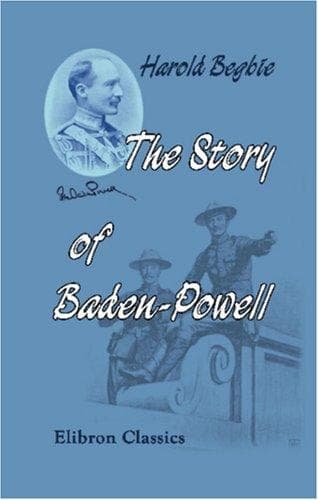
The Story of Baden-Powell: 'The Wolf That Never Sleeps'Begbie, Harold
History
The Story of Baden-Powell: 'The Wolf That Never Sleeps'
Begbie, Harold
Baden-Powell of Gilwell, Robert Stephenson Smyth Baden-Powell, Baron, 1857-1941
After distinguishing himself in this way, B.-P. came back to England,
in order to go through the Musketry Course at Hythe. Here he did
equally well, taking a First Class Extra Certificate, and a year after
we find him as Musketry Instructor at Quetta. But this book is not
intended to be a "biography" of Baden-Powell, and I shall beg leave to
relate no chronological record of his military career. We are telling
his story as a story, hoping to interest every English schoolboy who
has arrived at years of discretion, hoping to make them keen on sport,
keen on exercise, keen on open-air life, and hoping, in addition, to
be of real practical use to those whose eyes are now set hungrily on
Sandhurst.
In a later chapter it will be seen how Baden-Powell interested himself
in his men's welfare, and how he encouraged them to become real
soldiers--learned in things other than mere boot-cleaning and
button-polishing. Here we behold him as the gay and dashing Hussar, a
bold sportsman, a keen soldier, and one of the most popular men in
India.
His popularity, it is only fair to say, was earned very largely by
that gift for acting which had won him fame as a schoolboy. Whispers
that he was going to act in the _Area Belle_, or one of Gilbert and
Sullivan's operas, travelled with amazing rapidity from station to
station in India, and every performance in which he took part was
attended by all the Europeans for miles round. Indeed his fame as an
actor travelled so far afield that the manager of a London theatre
wrote to him in India offering our astonished hero a position in his
company at a salary of ten pounds a week! There is never an occasion
when B.-P. is not willing to get up theatricals. A few months after
the siege of Kandahar he arranged for a performance of _The Pirates of
Penzance_ in that barbarous city, making himself responsible for the
entire management. The dresses were excellent, the stage and scenery
good, and the opera was received with intense enthusiasm; and yet
there was not a single European woman there; all the dresses and
costumes were the work of B.-P., who himself appeared in the character
of Ruth! On another occasion, when _Trial by Jury_ was to be given, it
was discovered at the last moment, to the consternation of every one
except B.-P., that there were no Royal arms. In a few hours he
produced what I am assured was the most splendid and gorgeous national
emblazonry that ever sparkled behind footlights. He had collected a
few crude paints from the natives of the district, and had painted the
arms with an old shaving-brush. Such is his resourcefulness. And what
of his enthusiasm? When he was home in England on sick-leave he sent
out to the 13th Hussars the book of _Les Cloches de Corneville_, with
excellent sketches of the dresses and hints as to its staging. Again,
he has been known to get off a sick-bed in India in order to take part
in some entertainment for the amusement of soldiers.
Public-domain text, read in full here on John Shaqi.
Reviews
Reviews
No reviews yet
Be the first to share your thoughts on this work.
Join the Discussion
Join the discussion
Sign in to leave a comment or review.
Sign InorCreate an account