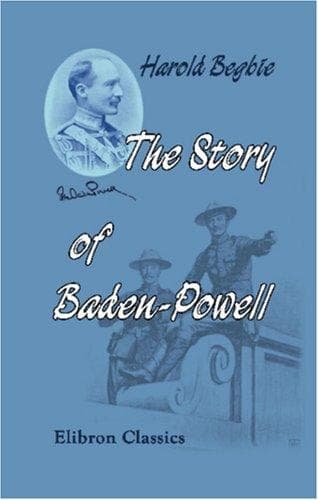
The Story of Baden-Powell: 'The Wolf That Never Sleeps'Begbie, Harold
History
The Story of Baden-Powell: 'The Wolf That Never Sleeps'
Begbie, Harold
Baden-Powell of Gilwell, Robert Stephenson Smyth Baden-Powell, Baron, 1857-1941
Hunting the boar takes place early in the morning and again in the
evening, so that men find themselves with nothing to do for the
greater part of the day. This time is usually spent in the tent
sketching, dozing, and reading, with occasional "goes" of claret cup.
But it is characteristic of Baden-Powell that he should give useful
advice concerning these waste hours. "If you prefer not to waste this
time altogether," he says, "it is a good practice to take a few books
and dictionary of any foreign language you may wish to be learning."
Again, his character as a thoughtful man may be seen in the warning he
gives novices against ill-treating villagers, or allowing the shikaris
to do so. "Shouting and cursing at a coolie already dumbfoundered at
the very sight of a white man is not the way to clear his
understanding." His remark that native servants under cover of their
master's prestige will frequently tyrannise over the villagers reminds
me of a story which I cannot forbear to tell. A bridge had been thrown
over a river in some outlandish part of India, and his work done, the
Englishman in charge was returning to more civilised regions. Just
before turning his back on the scene of his labours he inquired of a
villager whether he was pleased with the bridge. The man expressed
voluble admiration for the sahib's great skill, but lamented the high
toll that was charged for crossing the bridge. "Toll!" exclaimed the
Briton, "why, there's no toll at all; the bridge is free to
everybody." But the native still protesting that a charge was made,
and saying that a notice to that effect was written up in big English
letters, the engineer went down to the bridge himself to investigate
the mystery. There he discovered his own servant sitting at the
receipt of custom, with a flaming advertisement of Beecham's Pills
pasted on to a board over his head, to which he pointed as his
authority when questioned by rebellious natives.
Baden-Powell tells an amusing story of an impromptu boar hunt. "At a
grand field-day at Delhi, in the presence of all the foreign
delegates, in 1885, a boar suddenly appeared upon the scene and
charged a Horse Artillery gun, effectually stopping it in its advance
at a gallop by throwing down two of the horses. The headquarters staff
and the foreign officers were spectators of this deed, and hastened to
sustain the credit of the Army by seizing lances from their orderlies
and dashing off in pursuit of the boar, who was now cantering off to
find more batteries on which to work his sweet will. The staff,
however, were too quick for him, and, after a good run and fight, he
fell a victim to their attentions, amidst a chorus of _vivas_,
_sacres_, and _houplas_."
Public-domain text, read in full here on John Shaqi.
Reviews
Reviews
No reviews yet
Be the first to share your thoughts on this work.
Join the Discussion
Join the discussion
Sign in to leave a comment or review.
Sign InorCreate an account