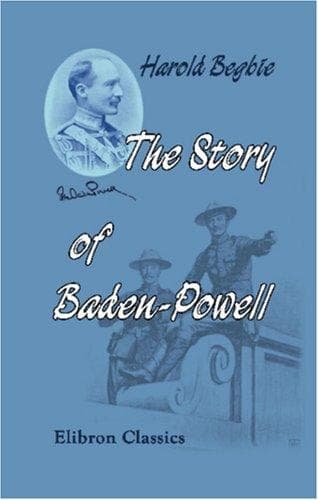
The Story of Baden-Powell: 'The Wolf That Never Sleeps'Begbie, Harold
History
The Story of Baden-Powell: 'The Wolf That Never Sleeps'
Begbie, Harold
Baden-Powell of Gilwell, Robert Stephenson Smyth Baden-Powell, Baron, 1857-1941
NOTE.--This deduction proved correct. On returning from my walk
I struck the same track (_i.e._ the wobbly wheel and the one shod
man) on another road, going ahead of me. I soon overtook them,
and found an old invalid lady being driven in a hired bazaar
rickshaw.
While following the tracks of the rickshaw, I noticed fresh
tracks of two horses coming towards me, followed by a big dog.
_They had passed since the rickshaw_ (overriding its tracks).
_They were cantering_ (two single hoof-prints, and then two near
together).
_A quarter of a mile farther on they were walking_ for a quarter
of a mile. (Hoof-prints in pairs a yard apart.) Here the dog
dropped behind, and had to make up lost ground by galloping
up to them. (Deep impression of his claws, and dirt kicked
up.)
_They had finished the walk about a quarter of an hour_ before I
came there. (Because the horse's droppings at this point
were quite fresh; covered with flies; not dried outside by
the sun.)
_They had been cantering up to the point where they began the
walk, but one horse had shied violently on passing the
invalid in the rickshaw._ (Because there was a great kick up
of gravel and divergence from its track just where the
rickshaw track bent into the side of the road, and
afterwards overrode the horse's tracks.)
NOTE.--I might have inferred from this that the invalid was
carrying an umbrella which frightened the horse, and was,
therefore, a lady. But I did not think of it at the time and had
rather supposed from the earliness of the hour that the invalid
was a man. Invalid ladies don't, as a rule, get up so early.
_Deduction_
_The tracks were those of a lady and gentleman out for a ride,
followed by her dog._
Because had the horses been only out exercising with syces they
would have been going at a walk in single file (or possibly at a
tearing gallop).
They were therefore ridden by white people, one of whom was a
lady; because, 1st, a man would not take a big, heavy dog to pound
along after his horse (it had pounded along long after the horses
were walking); 2nd, a man would not pull up to walk because his
horse had shied at a rickshaw; but a lady might, especially if
urged to do so by a man who was anxious about her safety, and that
is why I put them down as a man and a lady. Had they been two
ladies, the one who had been shied with would have continued to
canter out of bravado. And the man, probably, either a very
affectionate husband or no husband at all.
NOTE.--I admit that the above deductions hinge on very
little--one link might just be wrong and so break the whole chain.
This is often, indeed generally, the case, and corroborative
evidence should always be sought for.
Public-domain text, read in full here on John Shaqi.
Reviews
Reviews
No reviews yet
Be the first to share your thoughts on this work.
Join the Discussion
Join the discussion
Sign in to leave a comment or review.
Sign InorCreate an account