As we have already noticed in connection with the Mazarin Bible, the
forms of the types were copied from the Gothic or black letter
characters in which Bibles, psalters, and missals were then written.
When Roman type was first cut is uncertain. The "R" printer of
Strasburg, whose name is unknown, and whose works are dated only by
conjecture, may have been the first to use it. It was employed by
Sweynheim and Pannartz in 1467, and by the first printers in Paris and
Venice. It was brought to the greatest perfection by Nicolas Jenson, a
Frenchman working in Venice. Caxton never employed it, and it was not
introduced into England until 1509. In that year Richard Pynson, a
London printer and a naturalised Englishman, though Norman by birth,
used some Roman type in portions of the _Sermo Fratris Hieronymi de
Ferrara_, and in 1518 he produced _Oratio Ricardi Pacaei_, which was
entirely printed in these characters.
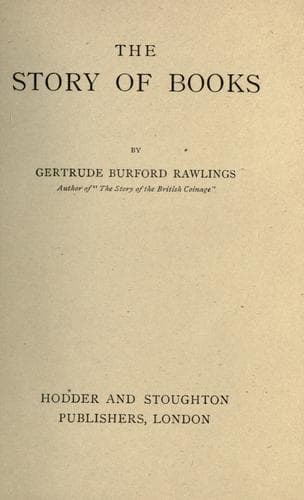
Had the idea of the title-page, in the modern sense of the term, a very
obvious idea, as it seems to us, occurred to the first printers, we
should not have to sharpen our wits on the hundred and one doubtful
points with which the subject of early bibliography bristles. To-day,
the title-page not only introduces the book itself, but declares the
name of the writer and the publisher, and the time and place of
publication. But during the first sixty years of printing title-pages
were rare, and the old methods followed by the scribes in writing their
manuscript books still obtained. The subject matter began with "Incipit"
or "Here beginneth," etc., according to the language in which the work
was written, and such information as the printer considered it desirable
to impart was contained in the colophon, or note affixed to the end of
the book.
Public-domain text, read in full here on John Shaqi.
Reviews
Reviews
No reviews yet
Be the first to share your thoughts on this work.
Elsewhere in the archive
Join the Discussion
Join the discussion
Sign in to leave a comment or review.
Sign InorCreate an account