More often than not these colophons are irritatingly reticent, and
withhold the very thing we want to know. At other times they are
informing, and in some cases amusing. Dr Garnett has suggested that as a
literary pastime some one might do worse than collect fifteenth-century
colophons into a volume, for the sake of their biographical and personal
interest, but I am not aware that his idea has been carried out. Two
colophons have already been quoted here, the first printed colophon (see
p. 103) and one which is possibly from the pen of Gutenberg (see
p. 101). A quaint specimen found in a volume of Cicero's _Orationes
Philippicæ_, printed at Rome by Ulrich Hahn, about 1470, descends to
puns. It is in Latin verse, and supposed by some to have been written by
Cardinal Campanus, who edited several of Hahn's publications. It informs
the descendants of the Geese who saved the Capitol, that they need have
no more fear for their feathers, for the art of Ulrich the _Cock_
(German _Hahn_ = Latin _Gallus_ = English _Cock_) will provide a potent
substitute for quills. A colophon to Cicero's _Epistolæ Familiares_,
printed at Venice in 1469 by Joannes de Spira, declares with pardonable
pride that he had printed two editions of three hundred copies in four
months.
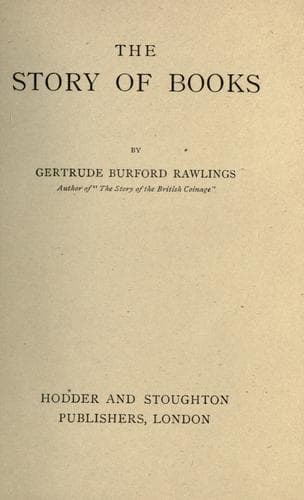
The first book with any attempt at a title-page is the _Sermo ad Populum
Predicabilis_, printed at Cologne in 1470 by Arnold Therhoernen, but a
full title-page was not generally adopted till fifty years later. The
first English title-page is very brief, and reads as follows:--
A passing gode lityll boke necessarye & behouefull agenst the
Pestilence.
This gode lityll boke, written by Canutus, Bishop of Aarhaus, was
printed in London about 1482 by Machlinia. A later development of the
title-page was a full-page woodcut, headed by the name of the work, as
in the =Kynge Richarde cuer du lyon=, printed in 1528 by Wynkyn de
Worde. The same woodcut does duty in another of the same printer's books
for Robert the Devil.
Early title-pages in Latin sometimes render the names of familiar places
of publication in a very unfamiliar form. London may appear as Augusta
Trinobantum, Edinburgh as Aneda, Dublin as Eblana. Some towns are easily
recognised by their Latin names, such as Roma or Venetiæ; others are
less obvious, such as Moguntia, or Mentz; Lutetia, or Paris; Argentina,
or Strasburg. Several places had more than one Latin form of name.
London, for example, was also Londinum, and Edinburgh, Edemburgem.
Pagination, or numbering of the pages, was first introduced by Arnold
Therhoernen, in the same book in which he gives us the first title-page,
and to which reference has already been made. He did not place the
figures at the top corner, however, but in the centre of the right hand
margin.
Public-domain text, read in full here on John Shaqi.
Reviews
Reviews
No reviews yet
Be the first to share your thoughts on this work.
Elsewhere in the archive
Join the Discussion
Join the discussion
Sign in to leave a comment or review.
Sign InorCreate an account