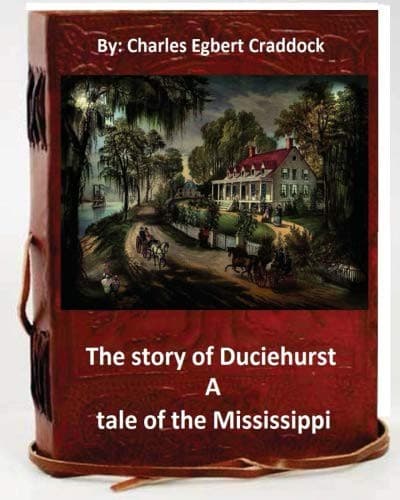
The Story of Duciehurst: A Tale of the MississippiCraddock, Charles Egbert
General
The Story of Duciehurst: A Tale of the Mississippi
Craddock, Charles Egbert
Mississippi River -- Fiction
And thus it was that his home had fallen to decay; his barns and fences
rotted; his gin was broken and patched and deteriorated in common with
all his farm machinery; his hedges of Cherokee rose, widened, unpruned
and untended, becoming veritable land grabbers, rather than boundaries,
and yearly more and more of his acres must needs be rented for lack of
funds to pay a force of laborers. Colonel Kenwynton lived on in his
mortgaged home and “scuffled up the money,” as he phrased the process,
to meet the interest year by year, and kept but sorry cheer by a bleak
and lonely fireside. Nevertheless, he twirled up the ends of his white
mustachios jauntily and faced the world with a bold front.
From his own account it seemed wonderful that he had any income at all,
and as if much business tact must be requisite to hold his mortgages
together in such shape that they should assume all the enlightened
functions of a fortune. The age of some of these obligations was a
source of special pride with him, although sometimes with an air of
important dismay he would compute the amount of interest he had paid in
the course of years on their several renewals aggregating more than the
property would sell for in the present collapsed condition of such real
estate values. When he came to speak of the interest he had promised to
pay, he would pause with an imperative shake of the head, as if to abash
the futurity which was fast bringing about the maturity of these notes.
“Why, Colonel, this is not good business,--you have practically bought
your own property twice over,” Treherne attempted to argue with him one
day when his mood waxed confidential. “You should have given up the
fight long ago and let them foreclose.”
“Foreclose on my home place, sir,--the remnant of my father’s
plantation?” he replied in amaze. “Why, what would the snail do without
the shell he was born with? I shall need a narrower one before that day
comes, I humbly trust in Providence.”
Colonel Kenwynton could scarcely imagine existence without a mortgage. A
deed of trust seemed as natural and essential an incident of a holding
in fee simple as the title papers.
Treherne discovered as time went on opportunities for betterment in the
Colonel’s affairs, small it is true, pitiful in comparison with the
ideals of the old gentleman, who lifted his brows in compassionate
surprise when the subject was broached, and, but that he could not
contravene the common sense of the proposition, he might have thought it
an insane impulse, manifesting itself in schemes of domestic economy on
a minute scale.
“Colonel, this place ought to make its own meat. There is plenty of corn
in that rearward barn. I put a padlock on its door to-day. Those young
shoats will be as fine a lot of meat as ever stepped by hog-killing
time. I had them turned into the oak woods to-day,--to give them a
chance at the mast,--makes the meat streaked lean and fat, you know.”
Public-domain text, read in full here on John Shaqi.
Reviews
Reviews
No reviews yet
Be the first to share your thoughts on this work.
Elsewhere in the archive
Join the Discussion
Join the discussion
Sign in to leave a comment or review.
Sign InorCreate an account