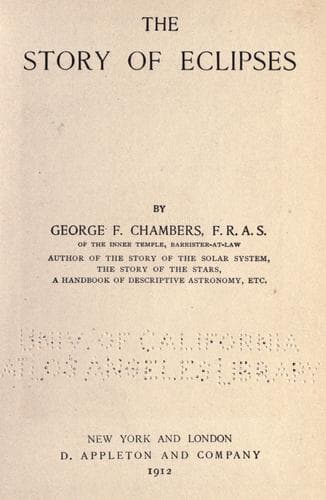
The Story of EclipsesChambers, George F. (George Frederick)
History
The Story of Eclipses
Chambers, George F. (George Frederick)
Eclipses
forwarding of messages from northern stations on the eclipse line to
southern stations. Some attention was being given at that time to the
question of Intra-Mercurial planets, and it was thought that if by good
fortune any such objects were unexpectedly found at the northern
station, and observers at a southern station could be advised of the
fact, there might be a better chance of procuring an accurate and
precise record of the discovery. As it happened, nothing came of it on
that occasion, but the idea of utilising the telegraph having once taken
possession of men’s minds, it was soon seen what important possibilities
were opened up.
The want of telegraph organisation curiously made itself felt in the
Egyptian eclipse of 1882. It is stated in another chapter of this work
that during the total phase a comet was unexpectedly discovered. Now
comets sometimes move very rapidly (especially when they are near the
Sun), and had it been possible to have warned some observer to the E. of
Egypt to look out for this comet, and had he seen it even only a couple
of hours after it had been found in Egypt, some data respecting its
position might have been obtained which would have permitted a rough
estimate being formed of its movement through the heavens. Such an
estimate might have enabled astronomers to have hunted up the comet at
sunset or sunrise on the days immediately following the eclipse. As it
happened, however, the comet was not seen again in 1882, and, so far as
we know, may never be seen again.
It was not till 1889 that a complete organisation of a telegraph service
in connection with an eclipse was accomplished. The eclipse of January 1
of that year began in the Pacific and the line of totality touched land
in California, passing across North America to Manitoba. The first
Californian station was at Willows, and was occupied by a party from
Harvard College Observatory, who were supplied with an unusually
complete equipment of photographic apparatus, together with a large
camera for charting all the stars in the neighbourhood of the Sun, so as
to detect an Intra-Mercurial planet if one existed. The telegraph scheme
which had to be worked out was somewhat complicated, and one of the
chief actors in the scene has furnished a fairly full account of what
was done. First of all, a complete list of the instruments and of the
work proposed to be done by them had to be prepared. The weather
probabilities being everywhere very unsatisfactory, there was a
possibility of all degrees of success or failure, and one thing which
had to be prearranged for each station was a cypher code which should be
available for all the likely combinations of instruments, weather and
results. It was found that about one hundred words would suffice for the
necessary code, including words which would indicate in a sufficiently
precise manner the position of any new planet which a photograph might
disclose.
Public-domain text, read in full here on John Shaqi.
Reviews
Reviews
No reviews yet
Be the first to share your thoughts on this work.
Elsewhere in the archive
Join the Discussion
Join the discussion
Sign in to leave a comment or review.
Sign InorCreate an account