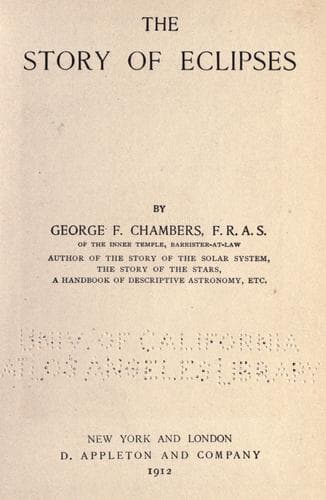
The Story of EclipsesChambers, George F. (George Frederick)
History
The Story of Eclipses
Chambers, George F. (George Frederick)
Eclipses
The last total eclipse of the Sun which has to be noticed as an
accomplished fact was the “Indian Eclipse” of Jan. 22, 1898, which was
very successfully seen by large numbers of people who went to India from
all parts of the world. As usual in all total eclipses of the Sun
nowadays, the photographers were very much to the front, and the
photographs of the inner Corona, taken by the Astronomer Royal, are
thought to have been probably the best that have yet been done. Amongst
the miscellaneous observations made, it may be mentioned that more stars
were seen during the second partial phases than during totality (a
circumstance which had been noticed by Don A. Ulloa as far back as
1778). It is stated also that a mysterious object was seen between Mars
and Venus by two officers of H.M.S. _Melpomene_, which was not put down
on the published chart as a star to be looked for. The identity of this
object has not been ascertained.
FOOTNOTES:
[Footnote 108: _Memoirs_, R.A.S., vol. x. p. 5.]
[Footnote 109: _L’Annuaire_, 1846, p. 303.]
[Footnote 110: _Month. Not._, R.A.S., vol. xx. p. 301; May 1860.]
CHAPTER XIV.
THE ELECTRIC TELEGRAPH AS APPLIED TO ECLIPSES OF THE SUN.
Amongst the auxiliary agencies which have been brought into use in
recent years, to enable astronomers the better to carry out systematic
observations of eclipses of the Sun, the electric telegraph occupies a
place which may hereafter become prominent. As it is not likely that
this little book will fall into the hands of any persons who would be
able to make much use of telegraphy in connection with eclipse
observations, it will not be necessary to give much space to the matter,
but a few outlines will certainly be interesting. When the idea of
utilising the telegraph wire first came into men’s minds, it was with
the object of enabling observers who saw the commencement of an eclipse
at one end of the line of totality, to give cautionary notices to
observers farther on, or towards the far end, of special points which
had been seen at the beginning of the totality, and as to which
confirmatory observations, at a later hour, were evidently very
desirable. It is obvious that a scheme of this kind depends for its
success upon each end (or something like it) of the line of totality
being in telegraphic communication with the other end, and this involves
a combination of favourable circumstances not likely to exist at every
occurrence of a total eclipse, and in general only likely to prevail in
the case of eclipses visible over inhabited territory, such as the two
Americas, Europe, and parts of Asia. This use of the telegraph was, I
think, first proposed as far back as 1878, by an American astronomer, in
connection with the total eclipse of that year. His proposal fell upon
sympathetic ears, with the result that arrangements were concluded with
the Western Union Telegraph Company of North America for the expeditious
Public-domain text, read in full here on John Shaqi.
Reviews
Reviews
No reviews yet
Be the first to share your thoughts on this work.
Elsewhere in the archive
Join the Discussion
Join the discussion
Sign in to leave a comment or review.
Sign InorCreate an account