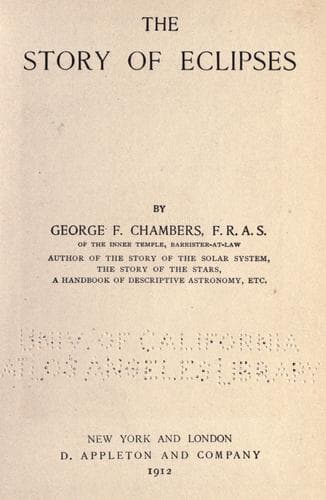
The Story of EclipsesChambers, George F. (George Frederick)
History
The Story of Eclipses
Chambers, George F. (George Frederick)
Eclipses
“During this interval the lunar shadow, advancing over Montana and
Dakota, had left the Earth entirely, sweeping off again into space.
Still, however, the prospect that the telegraph might win the race was
hopeful. Had New York been located in the eclipse path as well as
Willows, with both stations symmetrically placed, the total eclipse
would have become visible at New York about an hour and a quarter after
the shadow had left California. Thus there was time to spare. Having
recovered the wire, Professor Pickering’s message was completed at
10h. 36m. [G.M.T.], the cypher translated, and the stenographer’s notes
were written out and despatched to the composing-room six minutes later.
The “copy” was quickly put in type, and the hurried proof handed to
Professor Todd at 10h. 50m., exactly an hour of absolute time after the
observations were concluded. Had the Moon’s shadow been advancing from
California toward New York, there was still a margin of several minutes
before the eclipse could become total at the latter place. In point of
fact, while the proof sheet of the first message was being read, the
lunar shadow would have been loitering among the Alleghanies. Man’s
messenger had thus outrun the Moon. The telegraphic reports of the other
astronomers were gradually gathered and put in type, and the forms of
the _Herald_ were ready for the stereotyper at the proper time, some
two hours after midnight. At 3 o’clock a.m. the European mails closed,
and the pouches put on board the steamship _Aller_ carried the usual
copies for the foreign circulation. Within twenty-four hours after the
observations of the eclipse were made near the Pacific coast, the
results had been telegraphed to the Atlantic seaboard, collected and
printed, and the papers were well out on their journey to European
readers.”
The foregoing narrative will make amply clear the future possibilities
of telegraphy as a coadjutor of Astronomy in the observation of total
eclipses of the Sun. And if the will and the funds are forthcoming, the
eclipse of May 28, 1900, will afford an excellent opportunity of again
putting to the test the excellent ideas of which our American friends
worked out so successfully ten years ago. The zone of totality in that
eclipse passing as it will through so many of the densely populated
Southern States of North America, and then through Portugal, Spain, and
Algiers, great facilities will present themselves for telegraphic
combinations, if political and financial difficulties do not interfere.
FOOTNOTES:
[Footnote 111: There is a want of uniformity in Mrs. Todd’s
references to times which I have not thought it necessary to put
straight. “Greenwich Mean Time,” “Eastern U.S. Standard Time,” and
“Pacific Time,” are all severally quoted in happy-go-lucky
confusion.]
CHAPTER XV.
ECLIPSES OF THE MOON—GENERAL PRINCIPLES.
Public-domain text, read in full here on John Shaqi.
Reviews
Reviews
No reviews yet
Be the first to share your thoughts on this work.
Elsewhere in the archive
Join the Discussion
Join the discussion
Sign in to leave a comment or review.
Sign InorCreate an account