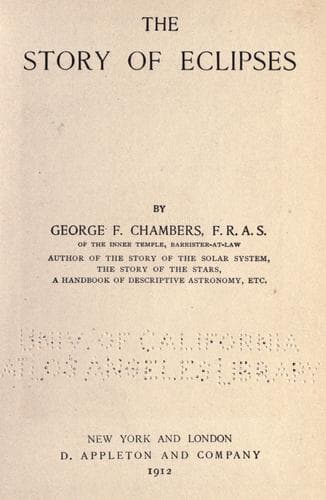
The Story of EclipsesChambers, George F. (George Frederick)
History
The Story of Eclipses
Chambers, George F. (George Frederick)
Eclipses
If the Saros comprised an exact number of days, each eclipse of a second
Saros series would be visible in the same regions of the Earth as the
corresponding eclipse in the previous series. But since there is a
surplus fraction of nearly one-third of a day, each subsequent eclipse
will be visible in another region of the Earth, which will be roughly a
third of the Earth’s circumference in longitude backwards (_i.e._ about
120° to the W.), because the Earth itself will be turned on its axis
one-third forwards.
After what has been said as to the Saros and its use it might be
supposed that a correct list of eclipses for 18.03 years would suffice
for all ordinary purposes of eclipse prediction, and that the sequence
of eclipses at any future time might be ascertained by adding to some
one eclipse which had already happened so many Saros periods as might
embrace the years future whose eclipses it was desired to study. This
would be true in a sense, but would not be literally and effectively
true, because corresponding eclipses do not recur exactly under the same
conditions, for there are small residual discrepancies in the times and
circumstances affecting the real movements of the Earth and Moon and the
apparent movement of the Sun which, in the lapse of years and centuries,
accumulate sufficiently to dislocate what otherwise would be exact
coincidences. Thus an eclipse of the Moon which in A.D. 565 was of 6
digits[7] was in 583 of 7 digits, and in 601 nearly 8. In 908 the
eclipse became total, and remained so for about twelve periods, or until
1088. This eclipse continued to diminish until the beginning of the 15th
century, when it disappeared in 1413. Let us take now the life of an
eclipse of the Sun. One appeared at the North Pole in June A.D. 1295,
and showed itself more and more towards the S. at each subsequent
period. On August 27, 1367, it made its first appearance in the North of
Europe; in 1439 it was visible all over Europe; in 1601, being its 19th
appearance, it was central and annular in England; on May 5, 1818, it
was visible in London, and again on May 15, 1836. Its three next
appearances were on May 26, 1854, June 6, 1872, and June 17, 1890. At
its 39th appearance, on August 10, 1980, the Moon’s shadow will have
passed the equator, and as the eclipse will take place nearly at
midnight (Greenwich M.T.), the phenomenon will be invisible in Europe,
Africa, and Asia. At every succeeding period the central line of the
eclipse will lie more and more to the S., until finally, on September
30, 2665, which will be its 78th appearance, it will vanish at the South
Pole.[8]
The operation of the Saros effects which have been specified above, may
be noticed in some of the groups of eclipses which have been much in
evidence (as will appear from a subsequent chapter), during the second
half of the 19th century. The following are two noteworthy Saros groups
of Solar eclipses:—
Public-domain text, read in full here on John Shaqi.
Reviews
Reviews
No reviews yet
Be the first to share your thoughts on this work.
Join the Discussion
Join the discussion
Sign in to leave a comment or review.
Sign InorCreate an account