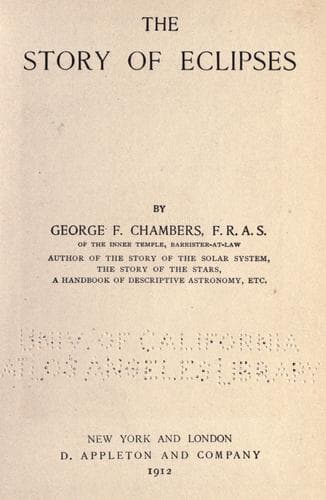
The Story of EclipsesChambers, George F. (George Frederick)
History
The Story of Eclipses
Chambers, George F. (George Frederick)
Eclipses
“On Monday last we were permitted to see the eclipse of the Sun in a
beautiful bright sky. Not a cloud was visible. We had made ample
preparation, laying in a stock of smoked glass several days in advance.
It was the grandest sight I ever beheld, but it frightened the Indians
badly. Some of them threw themselves upon their knees and invoked the
Divine blessing; others flung themselves flat on the ground, face
downward; others cried and yelled in frantic excitement and terror.
Finally one old fellow stepped from the door of his lodge, pistol in
hand, and fixing his eyes on the darkened Sun, mumbled a few
unintelligible words and raising his arm took direct aim at the
luminary, fired off his pistol, and after throwing his arms about his
head in a series of extraordinary gesticulations retreated to his own
quarters. As it happened, that very instant was the conclusion of
totality. The Indians beheld the glorious orb of day once more peep
forth, and it was unanimously voted that the timely discharge of that
pistol was the only thing that drove away the shadow and saved them from
the public inconvenience that would have certainly resulted from the
entire extinction of the Sun.”
A certain Mr. F. Kerigan, in a book published in 1844, made the
following remarks on ancient Jewish ideas respecting eclipses:—
“The Israelites, like their benighted neighbours, esteemed an eclipse of
either luminary as a supernatural and inauspicious omen, which filled
them with the most gloomy and fearful apprehensions: as may fairly be
deduced from the 8th chapter of Ezekiel, v. 15: ‘Then he brought me to
the door of the Lord’s House, which was towards the N.; and, behold
there sat women weeping for Tammuz.’ Now Tammuz is the name under which
Adonis was known in Palestine: he was the favourite of Venus, or
Astarte, the principal goddess of the Philistines and Phœnicians. Being
killed by a wild boar, the prevailing superstition of the age induced
the uninformed multitude to believe that when the Moon was eclipsed, it
was in complement to their beloved goddess Venus or Astarte, who,
concealed behind the full Moon, sat weeping under a dark veil for the
loss of her beloved Tammuz or Adonis.”[164]
Public-domain text, read in full here on John Shaqi.
Reviews
Reviews
No reviews yet
Be the first to share your thoughts on this work.
Elsewhere in the archive
Join the Discussion
Join the discussion
Sign in to leave a comment or review.
Sign InorCreate an account