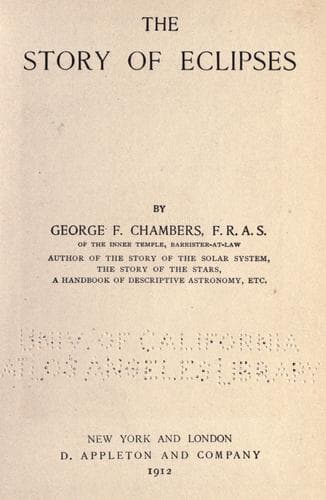
The Story of EclipsesChambers, George F. (George Frederick)
History
The Story of Eclipses
Chambers, George F. (George Frederick)
Eclipses
The African travellers, R. and J. Lander, have given[165] a graphic
account of what took place on the occasion of the eclipse of the Moon of
Sept. 2, 1830, as witnessed by themselves:—“The earlier part of the
evening had been mild, serene, and remarkably pleasant. The Moon had
arisen with uncommon lustre, and being at the full, her appearance was
extremely delightful. It was the conclusion of the holidays, and many of
the people were enjoying the delicious coolness of a serene night, and
resting from the laborious exertions of the day; but when the Moon
became gradually obscured, fear overcame every one. As the eclipse
increased they became more terrified. All ran in great distress to
inform their sovereign of the circumstance, for there was not a single
cloud to cause so deep a shadow, and they could not comprehend the
nature or meaning of an eclipse.... Groups of men were blowing on
trumpets, which produced a harsh and discordant sound; some were
employed in beating old drums, others again were blowing on bullocks’
horns.... The diminished light, when the eclipse was complete, was just
sufficient for us to distinguish the various groups of people, and
contributed in no small degree to render the scene more imposing. If a
European, a stranger to Africa, had been placed on a sudden in the midst
of the terror-struck people, he would have imagined himself to be among
a legion of demons, holding a revel over a fallen spirit.”
FOOTNOTES:
[Footnote 159: _Bibliographie Astronomique._ Paris, 1803. Indexed at
p. 938.]
[Footnote 160: _Authentic Account of an Embassy to China_, by Sir G.
Staunton.]
[Footnote 161: Fourth Series, vol. v. p. 676. October 24, 1868.]
[Footnote 162: _Report U.S. Coast Survey_, 1869, p. 179.]
[Footnote 163: Letter published in the _Philadelphia Inquirer_.]
[Footnote 164: _A Practical Treatise on Eclipses_, p. 2.]
[Footnote 165: _Journal of an Expedition to Explore the Niger_, vol.
i. p. 366.]
CHAPTER XIX.
ECLIPSES IN SHAKESPEARE AND THE POETS.
The sound of these words may be large but facts do not bear out the
theory, for eclipses do not appear to have captivated our great poets to
anything like the extent that Moon, Stars, and Comets have done.
Shakespeare has a few allusions to eclipses, but they are not of prime
importance. In _Macbeth_ we find:—
“And slips of yew
Shivered in the Moon’s eclipse”
—Act iv. sc. 1.
the precise meaning of which is not very obvious. “Shivered” of course
means divided into pieces, but the idea intended is obscure.
The next quotation is more comprehensive and reflects more plainly the
current of thought prevalent in Shakespeare’s day, albeit here again the
word “eclipse” will be found to stand without much definite connection
with what goes before. However the reader shall judge for himself:—
Public-domain text, read in full here on John Shaqi.
Reviews
Reviews
No reviews yet
Be the first to share your thoughts on this work.
Elsewhere in the archive
Join the Discussion
Join the discussion
Sign in to leave a comment or review.
Sign InorCreate an account