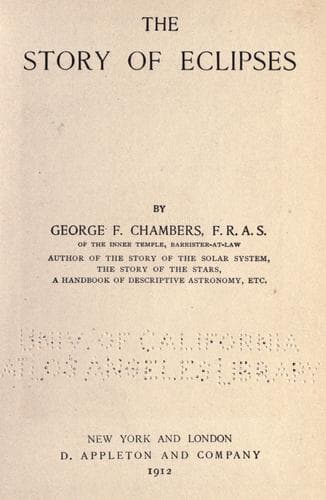
The Story of EclipsesChambers, George F. (George Frederick)
History
The Story of Eclipses
Chambers, George F. (George Frederick)
Eclipses
Until the eclipse has commenced these images will be tiny circles
overlapping one another, and of course each of these circles means so
many images of the Sun. These images indeed can be seen on any fine day,
and the circles increase in size in proportion to the height of the
foliage above the ground, being something like 1 inch for every 10 feet.
It may be remarked, by the way, that the images are circles, because the
Sun is a source of light having a circular outline, and is not a point
of light like a star. If it were, the outline of the foliage would be
reproduced on the ground leaf for leaf. It follows naturally from all
this that when in consequence of there being an eclipse in progress the
shape of the Sun’s contour gradually changes, so will the shape of the
Solar images on the ground change, becoming eventually so many
crescents. Moreover, the horns of the crescent-shaped images will be in
the reverse direction to the horns of the actual crescent of the Sun at
the moment, the rays of the Sun crossing as they pass through the
foliage, just as if each interstice were a lens.
Supposing there are some spots on the Sun at a time when an eclipse is
in progress the Moon’s passage over these spots may as well be noticed.
In bygone years some amount of attention was devoted to this matter with
the view of ascertaining whether any alteration took place in the
appearance of the spots; distortion, for instance, such as might be
produced by the intervention of a lunar atmosphere. No such distortion
was ever noticed, and observations with this idea in view may be said to
possess now only an academic interest, for it may be regarded as a
well-established fact that the Moon has no atmosphere.
During the passage of the Moon over Sun-spots an opportunity is afforded
of comparing the blackness, or perhaps we should rather say, the
intensity of the shade of a Sun-spot with the blackness of the Moon’s
disc. Testimony herein is unanimous that the blackness of the Moon
during the stages of partial eclipse is intense compared with the
darkest parts of a Sun-spot; and this, be it remembered, in spite of the
fact that during the partial phase the atmosphere between the observer
and the Sun is brilliantly illuminated, whilst the Moon itself, being
exposed to Earth-shine, is by no means absolutely devoid of all
illumination.
When the Moon is passing across the Sun there have often been noticed
along the limb of the Moon fringes of colour, and dark and bright bands.
This might not necessarily be a real appearance for it is conceivable
that such traces of colour might be due to the telescopes employed not
having been truly achromatic, that is, not sufficiently corrected for
colour; but making every allowance for this possible source of mistake
there yet remains proof that the colour which has often been seen has
been real.
Public-domain text, read in full here on John Shaqi.
Reviews
Reviews
No reviews yet
Be the first to share your thoughts on this work.
Join the Discussion
Join the discussion
Sign in to leave a comment or review.
Sign InorCreate an account