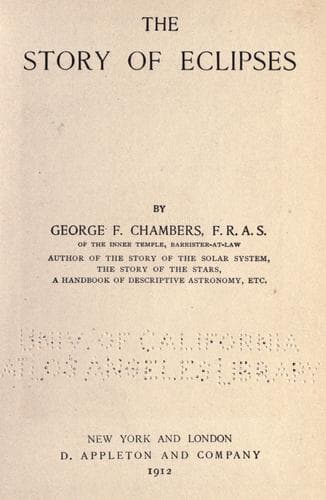
The Story of EclipsesChambers, George F. (George Frederick)
History
The Story of Eclipses
Chambers, George F. (George Frederick)
Eclipses
Let us suppose that we have a chance of observing a total eclipse of the
Sun; have completed all our preliminary preparations; have taken note of
everything which needs to be noted or suggests itself for that purpose
up till nearly the grand climax; and that the clock tells us that we are
within, say, five minutes of totality. Somewhere about this time perhaps
we shall be able to detect, dancing across the landscape, singular wavy
lines of light and shade. These are the “Shadow Bands,” as they are
called. The phrase is curiously inexplicit, but seemingly cannot be
improved upon at present because the philosophy of these
appearances—their origin and the laws which regulate their
visibility—are unknown, perhaps because amid the multitude of other
things to think about sufficient attention has hitherto not been paid to
the study of them. These shadow bands are most striking if a high
plastered wall, such as the front of a stone or stuccoed house, is in
their track as a screen to receive them. The shadow bands seem to vary
both in breadth and distance apart at different eclipses, and also in
the speed with which they pass along. Though, as already stated, little
is known of their origin yet they may be conceived to be due to
irregularities in the atmospheric refraction of the slender beam of
light coming from the waning or the waxing crescent of the Sun, for be
it understood they may be visible after totality as well as before it.
It is to be remarked that they have never been photographed.
[Illustration: FIG. 6.—SHADOW BANDS.]
In addition to the shadow bands there are instances on record of the
limbs of the Sun’s crescent appearing to undulate violently on the
approach of totality. These undulations were noticed by Airy in 1842
about 6 minutes before totality. Blake, in America in 1869, observed the
same phenomenon 8 minutes before totality. In other cases the interval
would seem to have been very much shorter—a mere matter of seconds. A
very singular observation was made in 1858 by Mr. J. D. Smith at Laycock
Abbey, Wiltshire, on the occasion of the annular eclipse of that year.
He says[13]:—“Both my brother and myself were distinctly impressed with
the conviction that the withdrawal of light was not continuous, but by
pulsations, or, as it were, waves of obscuration, the darkness
increasing by strokes which sensibly smote the eye, and were repeated
distinctly some five or seven times after we had remarked the phenomenon
and before the time of greatest obscuration. This did not occur on the
return of light, which came back continuously and without shock or
break.” Rümker mentions that though this phenomenon was very apparent to
the naked eye it was not visible in the telescope.
Public-domain text, read in full here on John Shaqi.
Reviews
Reviews
No reviews yet
Be the first to share your thoughts on this work.
Join the Discussion
Join the discussion
Sign in to leave a comment or review.
Sign InorCreate an account