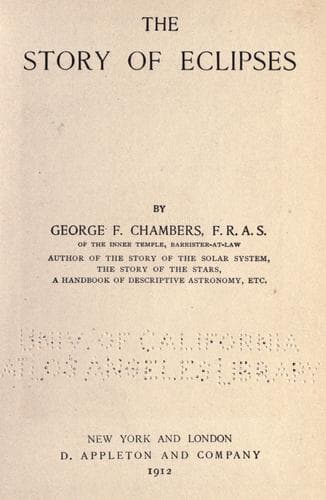
The Story of EclipsesChambers, George F. (George Frederick)
History
The Story of Eclipses
Chambers, George F. (George Frederick)
Eclipses
There are other causes likely to co-operate in bringing this about. It
is true that men’s minds are more enlightened at the end of the 19th
century than they were at the end of the 16th century, and that a trip
to Spain will awaken vastly different thoughts in the year 1900 to those
which would have been awakened, say in the year 1587; but for all that,
a certain amount of superstition still lingers in the world, and total
eclipses as well as comets still give rise to feelings of anxiety and
alarm amongst ill-educated villagers even in so-called civilized
countries. Some amusing illustrations of this will be presented in due
course. For the moment let me content myself by stating the immediate
aim of this little book, and the circumstances which have led to its
being written. What those circumstances are will be understood generally
from what has been said already. Its aim is the unambitious one of
presenting in readable yet sound scientific language a popular account
of eclipses of the Sun and Moon, and (very briefly) of certain kindred
astronomical phenomena which depend upon causes in some degree similar
to those which operate in connection with eclipses. These kindred
phenomena are technically known as “Transits” and “Occultations.”
Putting these two matters entirely aside for the present, we will
confine our attention in the first instance to eclipses; and as eclipses
of the Sun do not stand quite on the same footing as eclipses of the
Moon, we will, after stating the general circumstances of the case, put
the eclipses of the Moon aside for a while.
CHAPTER II.
GENERAL IDEAS.
The primary meaning of the word “Eclipse” (ἔϰλειψις) is a forsaking,
quitting, or disappearance. Hence the covering over of something by
something else, or the immersion of something in something; and these
apparently crude definitions will be found on investigation to represent
precisely the facts of the case.
Inasmuch as the Earth and the Moon are for our present purpose
practically “solid bodies,” each must cast a shadow into space as the
result of being illuminated by the Sun, regarded as a source of light.
What we shall eventually have to consider is: What results arise from
the existence of these shadows according to the circumstances under
which they are viewed? But before reaching this point, some other
preliminary considerations must be dealt with.
Public-domain text, read in full here on John Shaqi.
Reviews
Reviews
No reviews yet
Be the first to share your thoughts on this work.
Join the Discussion
Join the discussion
Sign in to leave a comment or review.
Sign InorCreate an account