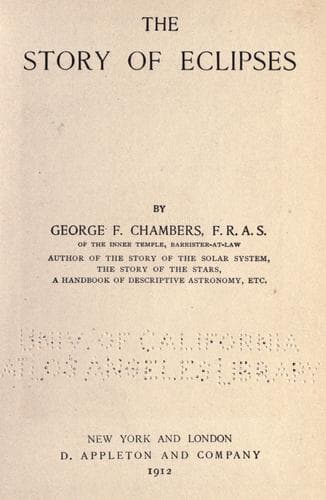
The Story of EclipsesChambers, George F. (George Frederick)
History
The Story of Eclipses
Chambers, George F. (George Frederick)
Eclipses
The substance of these statements is that in the year 310 B.C.
Agathocles, Tyrant of Syracuse, while conducting his fleet from Syracuse
to the Coast of Africa, found himself enveloped in the shadow of an
eclipse, which evidently, from the accounts, was total. His fleet had
been chased by the Carthaginians on leaving Syracuse the preceding day,
but got away under the cover of night. On the following morning about 8
or 9 a.m. a sudden darkness came on which greatly alarmed the sailors.
So considerable was the darkness, that numerous stars appeared. It is
not at the first easy to localise the position of the fleet, except that
we may infer that it could hardly have got more than 80 or at the most
100 miles away from the harbour of Syracuse where it had been closely
blockaded by a Carthaginian fleet. Agathocles would not have got away at
all but for the fact that a relieving fleet was expected, and the
Carthaginians were obliged to relax their blockade in order to go in
search of the relieving fleet. Thus it came about not only that
Agathocles set himself free, but was able to retaliate on his enemies by
landing on the coast of Africa at a point near the modern Cape Bon, and
devastating the Carthaginian territories. The voyage thither occupied
six days, and the eclipse occurred on the second day. Though we are not
informed of the route followed by Agathocles, that is to say whether he
passed round the North or the South side of the island of Sicily, yet it
has been made clear by astronomers that the southern side was that
taken.
Baily, who was the first modern astronomer to investigate the
circumstances of this eclipse, found that there was an irreconcilable
difference between the path of the shadow found by himself and the
historical statement, a gap of about 180 geographical miles seeming to
intervene between the most southerly position which could be assigned to
the fleet of Agathocles, and the most northerly possible limit of the
path of the eclipse shadow. This was the condition of the problem when
Sir G. B. Airy took it up in 1853.[55] He, however, was able to throw an
entirely new light upon the matter. The tables used by Baily were
distinctly inferior to those now in use, and Sir G. B. Airy thought
himself justified in saying that to obviate the discordance of 180 miles
just referred to “it is only necessary to suppose an error of 3′ in the
computed distances of the Sun and Moon at conjunction, a very
inconsiderable correction for a date anterior to the epoch of the tables
by more than twenty-one centuries.”
It deserves to be mentioned, though the point cannot here be dwelt upon
at much length, that these ancient eclipses all hang together in such a
way that it is not sufficient for the man of Astronomy and the man of
Chronology to agree on one eclipse, unless they can harmonise the facts
of several.
Public-domain text, read in full here on John Shaqi.
Reviews
Reviews
No reviews yet
Be the first to share your thoughts on this work.
Elsewhere in the archive
Join the Discussion
Join the discussion
Sign in to leave a comment or review.
Sign InorCreate an account