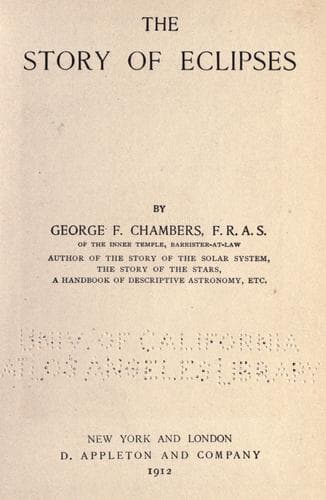
The Story of EclipsesChambers, George F. (George Frederick)
History
The Story of Eclipses
Chambers, George F. (George Frederick)
Eclipses
[Footnote 52: _Hellenics_, Book iv., chap. 3, sec. 10.]
[Footnote 53: _Bibliothecæ Historicæ_, Lib. xx., cap. 1, sec. 5.]
[Footnote 54: _Historia_, Lib. xxii., cap. 6.]
[Footnote 55: _Phil. Trans._, vol. cxliii. pp. 187-91, 1853.]
[Footnote 56: _Hist. Rom._, Lib. xxii., cap. 1.]
[Footnote 57: _Hist. Rome_, Book xli., chap. 14.]
[Footnote 58: _Naturalium Questionum_, Lib. vii.]
[Footnote 59: Homer, _Odyssey_, vol. ii. p. 328. Clarendon Press
Series.]
[Footnote 60: _Washington Observations_, 1875, Appendix II., p. 18.]
CHAPTER XI.
ECLIPSES OF THE SUN MENTIONED IN HISTORY.—
THE CHRISTIAN ERA TO THE NORMAN CONQUEST.
The Christian Era is, for several reasons, a suitable point of time from
which to take a new departure in speaking of historical eclipses,
although the First Century, at least, might obviously be regarded as
belonging to classical history—but let that pass.
Dion Cassius[61] relates that on a date corresponding to March 28, A.D.
5, the Sun was partly eclipsed. Johnston says that the central line
passed over Norway and Sweden. It seems, perhaps, a little strange that
a writer who lived in Bithynia in the 3rd Century of the Christian Era
should have picked up any information about something that happened in
the extreme North of Europe two centuries previously. But probably the
eclipse must have been seen in Italy.
On November 24, A.D. 29, there happened an eclipse of the Sun which is
sometimes spoken of as the “eclipse of Phlegon.” Eusebius, the
ecclesiastical historian, records Phlegon’s testimony. Phlegon was a
native of Tralles in Lydia, and one of the Emperor Adrian’s freedmen.
The eclipse in question happened at noon, and the stars were seen. It
was total, and the line of totality, according to Hind,[62] passed
across the Black Sea from near Odessa to Sinope, thence near the site of
Nineveh to the Persian Gulf. A partial eclipse with four-fifths of the
Sun’s diameter covered was visible at Jerusalem. This is the only solar
eclipse which was visible at Jerusalem during the period usually fixed
for Christ’s public ministry. This eclipse was for a long time, and by
various writers, associated with the darkness which prevailed at
Jerusalem on the day of our Lord’s Crucifixion, but there seems no
warrant whatever for associating the two events. The Crucifixion
darkness was assuredly a supernatural phenomenon, and there is nothing
supernatural in a total eclipse of the Sun. To this it may be added that
both Tertullian at the beginning of the 3rd century and Lucian, the
martyr of Nicomedia, who died in 312, appealed to the testimony of
national archives then in existence, as witnessing to the fact that a
supernatural darkness had prevailed at the time of Christ’s death.
Moreover, the generally recorded date of the Crucifixion, namely, April
3, A.D. 33, would coincide with a full Moon. As it happened, that full
Public-domain text, read in full here on John Shaqi.
Reviews
Reviews
No reviews yet
Be the first to share your thoughts on this work.
Elsewhere in the archive
Join the Discussion
Join the discussion
Sign in to leave a comment or review.
Sign InorCreate an account