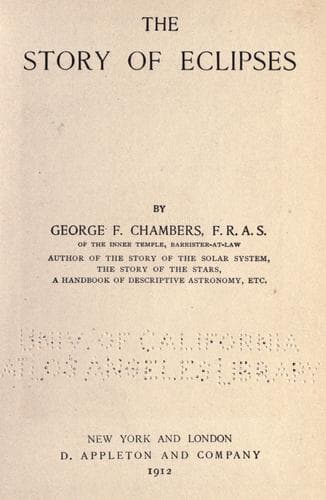
The Story of EclipsesChambers, George F. (George Frederick)
History
The Story of Eclipses
Chambers, George F. (George Frederick)
Eclipses
Moon suffered eclipse, but she emerged from the Earth’s shadow about a
quarter of an hour before she rose at Jerusalem (6 h. 36 m. p.m.): the
penumbra continued upon her disc for an hour afterwards.
Speaking of the Emperor Claudius, Dion Cassius[63] says:—“There was
going to be an eclipse on his birthday. Claudius feared some
disturbance, as there had been other prodigies, so he put forth a public
notice, not only that the obscuration would take place and about the
time and magnitude of it, but also about the causes which produce such
events.” This is an interesting statement, especially in view of what I
have said on a previous page about the indifference of the Romans to
Astronomy. It would, likewise, be interesting to know how Claudius
acquired his knowledge, and who coached him up in the matter. This
eclipse occurred on August 1, A.D. 45. Barely half the Sun’s diameter
was covered.
Philostratus[64] states that “about this time while he was pursuing his
studies in Greece such an omen was observable in the heavens. A crown
resembling Iris surrounded the disc of the Sun and darkened its rays.”
“About this time” is to be understood as referring to some date shortly
preceding the death of the Emperor Domitian which occurred on September
18, A.D. 96. This has usually been regarded as the earliest allusion to
what we now call the Sun’s “Corona”; or, as an alternative idea, that
the allusion is simply to an annular eclipse of the Sun. But both these
theories have been called in question; by Johnston because he cannot
find an eclipse which in his view of things will respond as regards date
to the statement of Philostratus, and by Lynn on the same ground and on
other grounds, _more suo_. The question of identification requires
looking into more fully. There was a total eclipse on May 21, A.D. 95,
but it was only visible as a partial eclipse in Western Asia and not
visible at all in Greece. This is given as the conclusion arrived at by
the German astronomer Ginzel. But it does not seem to me sufficient to
overthrow, without further investigation, the fairly plain language of
Philostratus, which is possibly confirmed by a passage in Plutarch[65]
in which he discusses certain eclipse phenomena in the light of a recent
eclipse. The date of Plutarch’s “recent” eclipse is somewhat uncertain,
but that fact does not necessarily militate against his testimony
respecting the Corona or what is regarded to have been such. The
statement of Philostratus, treated as a mention of a total solar
eclipse, is accepted as sufficiently conclusive by Sir W. Huggins and
the late Professor R. Grant. Johnston, to meet the supposed difficulty
of finding an eclipse to accord with the assertion of the historian,
suggests that “perhaps some peculiar solar halo or mock Sun, or other
meteorological formation” is referred to. But Stockwell has advanced
very good reasons for the opinion that the eclipse of Sept. 3, A.D. 118,
fully meets the circumstances of the case.
Public-domain text, read in full here on John Shaqi.
Reviews
Reviews
No reviews yet
Be the first to share your thoughts on this work.
Elsewhere in the archive
Join the Discussion
Join the discussion
Sign in to leave a comment or review.
Sign InorCreate an account