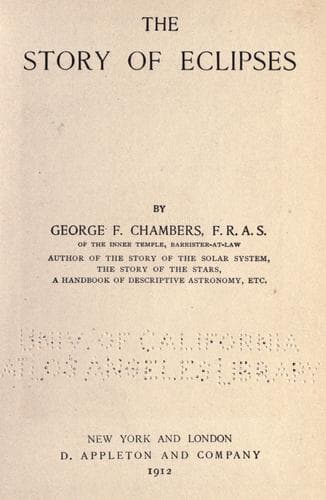
The Story of EclipsesChambers, George F. (George Frederick)
History
The Story of Eclipses
Chambers, George F. (George Frederick)
Eclipses
CHAPTER XII.
ECLIPSES OF THE SUN MENTIONED IN HISTORY.—
MEDIÆVAL AND MODERN.
One of the most celebrated eclipses of mediæval times was that of August
2, 1133, visible as a total eclipse in Scotland. It was considered a
presage of misfortune to Henry I. and was thus referred to by William of
Malmesbury[80]:—
“The elements manifested their sorrow at this great man’s last departure
from England. For the Sun on that day at the 6th hour shrouded his
glorious face, as the poets say, in hideous darkness agitating the
hearts of men by an eclipse; and on the 6th day of the week early in the
morning there was so great an earthquake that the ground appeared
absolutely to sink down; an horrid noise being first heard beneath the
surface.”
This eclipse is also alluded to in the _Anglo-Saxon Chronicle_ though
the year is wrongly given as 1135 instead of 1133 as it certainly was.
The _Chronicle_ says:—“In this year King Henry went over sea at Lammas,
and the second day as he lay and slept on the ship the day darkened over
all lands; and the Sun became as it were a three-night-old Moon, and the
stars about it at mid-day. Men were greatly wonder-stricken and
affrighted, and said that a great thing should come hereafter. So it
did, for the same year the king died on the following day after St.
Andrew’s Mass day, Dec. 2, in Normandy.” The king did die in 1135, but
there was no eclipse of the August new Moon, and without doubt the
writer has muddled up the year of the eclipse and of the king’s
departure from England (to which he never returned) and the year of his
death. Calvisius states that this eclipse was observed in Flanders and
that the stars appeared.
Respecting the above-mentioned discrepancy Mrs. Todd aptly remarks:—“So
Henry must have died in 1133, which he _did not_; or else there must
have been an eclipse in 1135, which there _was not_. But this is not the
only labyrinth into which chronology and old eclipses, imagination, and
computation, lead the unwary searcher.” Professor Freeman’s explanation
fairly clears up the difficulty:—“The fact that he never came back to
England, together with the circumstances of his voyage, seems to have
made a deep impression on men’s minds. In popular belief the signs and
wonders which marked his last voyage were transferred to the Lammas-tide
before his death two years later.”[81] The central line of this eclipse
traversed Scotland from Ross to Forfar and the eclipse was of course
large in every part of the country. The totality lasted 4m. 20s. in
Forfarshire.
Public-domain text, read in full here on John Shaqi.
Reviews
Reviews
No reviews yet
Be the first to share your thoughts on this work.
Elsewhere in the archive
Join the Discussion
Join the discussion
Sign in to leave a comment or review.
Sign InorCreate an account