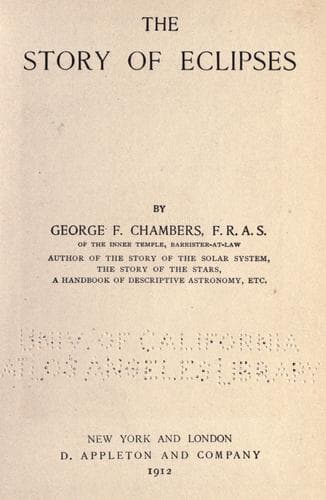
The Story of EclipsesChambers, George F. (George Frederick)
History
The Story of Eclipses
Chambers, George F. (George Frederick)
Eclipses
The eclipse of April 8, 1652, is another of those Scotch eclipses, as we
may call them, which left their mark on the people of that country.
Maclaurin[94] speaks of it in his time (he died in 1746) as one of the
two central eclipses which are “still famous among the populace in this
country” [Scotland], and “known amongst them by the appellation of Mirk
Monday.” The central line passed over the S.E. of Ireland, near Wexford
and Wicklow, and reaching Scotland near Burrow Head in Wigtownshire, and
passing not far from Edinburgh, Montrose and Aberdeen, quitted Scotland
at Peterhead. Greenock and Elgin were near the northern limit of the
zone of totality, and the Cheviots and Berwick upon the southern limit.
The eclipse was observed at Carrickfergus by Dr. Wyberd.[95] Hind found
that its duration there was but 44s. This short duration, he suggested,
may partly explain the curious remark of Dr. Wyberd that when the Sun
was reduced to “a very slender crescent of light, the Moon all at once
threw herself within the margin of the solar disc with such agility that
she seemed to revolve like an upper millstone, affording a pleasant
spectacle of rotatory motion.” Wyberd’s further description clearly
applies to the Corona. A Scotch account says that “the country people
tilling, loosed their ploughs. The birds dropped to the ground.”
The eclipse of November 4, 1668, visible as a partial one in England,
was of no particular interest in itself but deserves notice as having
been observed by Flamsteed,[96] who gives a few diagrams of his
observations at Derby. He states that the eclipse came on much earlier
than had been predicted. It was well known at this time that the tables
of the Sun and Moon then in use were very defective, and it was a
recognition of this fact which eventually led to the foundation of the
Greenwich Observatory in 1675.
On September 23, 1699, an eclipse of the Sun occurred which was total to
the N. of Caithness for the very brief space of 10-15 secs. At
Edinburgh, about 11/12ths of the Sun’s diameter was obscured. In the
Appendix to Pepys’s _Diary_[97] there is a letter from Dr. Wallis
mentioning that his daughter’s attention was called to it by noticing
“the light of the Sun look somewhat dim” at about 9 a.m., whilst she
was writing a letter, she knowing nothing of the eclipse.
Public-domain text, read in full here on John Shaqi.
Reviews
Reviews
No reviews yet
Be the first to share your thoughts on this work.
Elsewhere in the archive
Join the Discussion
Join the discussion
Sign in to leave a comment or review.
Sign InorCreate an account