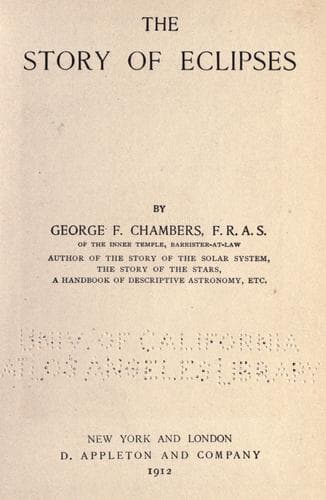
The Story of EclipsesChambers, George F. (George Frederick)
History
The Story of Eclipses
Chambers, George F. (George Frederick)
Eclipses
An eclipse of the Sun occurred on May 12, 1706, which was visible as a
partial eclipse in England and was total on the Continent, especially in
Switzerland. A certain Captain Stannyan who made observations at Berne,
writes thus to Flamsteed[98]:—“That the Sun was totally darkened there
for four and a half minutes of time; that a fixed star and a planet
appeared very bright; _and that his getting out of his eclipse was
preceded by a blood-red streak of light from its left limb, which
continued not longer than six or seven seconds of time_; then part of
the Sun’s disc appeared all of a sudden as bright as Venus was ever seen
in the night; nay, brighter; and in that very instant gave a light and
shadow to things as strong as the Moon uses to do.”
On this communication Flamsteed remarks:—“The Captain is the first man I
ever heard of that took notice of a red streak preceding the emersion of
the Sun’s body from a total eclipse, and I take notice of it to you [the
Royal Society], because it infers that the Moon has an atmosphere; and
its short continuance, if only six or seven seconds’ time, tells us that
its height was not more than five or six hundredths part of her
diameter.”
On the whole, perhaps, the most celebrated eclipse of the Sun ever
recorded in England was that of May 3, 1715. The line of totality passed
right across England from Cornwall to Norfolk, and the phenomenon was
carefully observed and described by the most experienced astronomer of
the time, Dr. Edmund Halley. The line of totality passed over London
amongst other places, and as the maximum phase took place soon after 9
a.m. on a fine spring morning, the inhabitants of the Metropolis saw a
sight which their successors will not see again till many generations
have come and gone. Halley has left behind him an exceedingly
interesting account of this event, some allusions to which have already
been made.
He seems to have seen what we call the Corona, described by him however
as a “luminous ring,” “of a pale whiteness, or rather pearl colour, a
little tinged with the colours of the Iris, and concentric with the
Moon.” He speaks also of a dusky but strong red light which seemed to
colour the dark edge of the Moon just before the Sun emerged from
totality. Jupiter, Mercury, Venus, and the stars Capella and Aldebaran
were seen in London, whilst N. of London, more directly under the
central line, as many as twenty stars were seen.
Public-domain text, read in full here on John Shaqi.
Reviews
Reviews
No reviews yet
Be the first to share your thoughts on this work.
Elsewhere in the archive
Join the Discussion
Join the discussion
Sign in to leave a comment or review.
Sign InorCreate an account