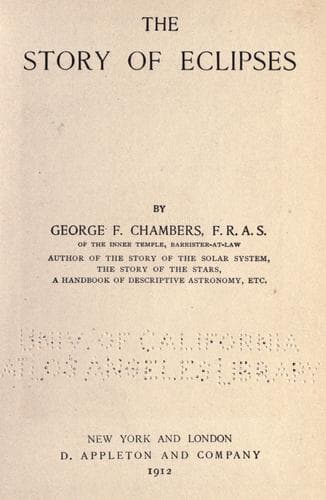
The Story of EclipsesChambers, George F. (George Frederick)
History
The Story of Eclipses
Chambers, George F. (George Frederick)
Eclipses
To bring about an eclipse of the Sun, two things must combine: (1) the
Moon must be at or near one of its Nodes; and (2), this must be at a
time when the Moon is also in “Conjunction” with the Sun. Now the Moon
is in Conjunction with the Sun (= “New Moon”) 12 or 13 times in a year,
but the Sun only passes through the Nodes of the Moon’s orbit twice a
year. Hence an eclipse of the Sun does not and cannot occur at every New
Moon, but only occasionally. An _exact_ coincidence of Earth, Moon, and
Sun, in a straight line at a Node is not necessary to ensure an eclipse
of the Sun. So long as the Moon is within about 18½° of its Node, with a
latitude of not more than 1° 34′, an eclipse _may_ take place. If,
however, the distance is less than 15¼° and the latitude less than
1° 23′ an eclipse _must_ take place, though between these limits[4] the
occurrence of an eclipse is uncertain and depends on what are called the
“horizontal parallaxes” and the “apparent semi-diameters” of the two
bodies at the moment of conjunction, in other words, on the nearness or
“far-offness” of the bodies in question. Another complication is
introduced into these matters by reason of the fact that the Nodes of
the Moon’s orbit do not occupy a fixed position, but have an annual
retrograde motion of about 19¼°, in virtue of which a complete
revolution of the Nodes round the ecliptic is accomplished in 18 years
218⅞ days (= 18.5997 years).
The backward movement of the Moon’s Nodes combined with the apparent
motion of the Sun in the ecliptic causes the Moon in its monthly course
round the Earth to complete a revolution with respect to its Nodes in a
less time (27.2 days) than it takes to get back to Conjunction with the
Sun (29.5 days); and a curious consequence, as we shall see directly,
flows from these facts and from one other fact. The other fact is to the
Sun starting coincident with one of the Moon’s Nodes, returns on the
Ecliptic to the same Node in 346.6 days. The first named period of 27.2
days is called the “_Nodical_ Revolution of the Moon” or “Draconic
Month,” the other period of 29.5 days is called the “_Synodical_
Revolution of the Moon.” Now the curious consequence of these figures
being what they are is that 242 Draconic Months, 223 Lunations, and 19
Returns of the Sun to one and the same Node of the Moon’s orbit, are all
accomplished in the same time within 11 hours. Thus (ignoring
refinements of decimals):—
Days Days. Years. Days. Hours.
242 times 27.2 = 6585.36 = 18 10 8½
223 times 29.5 = 6585.32 = 18 10 7¾
19 times 346.6 = 6585.78 = 18 10 18¾
Public-domain text, read in full here on John Shaqi.
Reviews
Reviews
No reviews yet
Be the first to share your thoughts on this work.
Join the Discussion
Join the discussion
Sign in to leave a comment or review.
Sign InorCreate an account