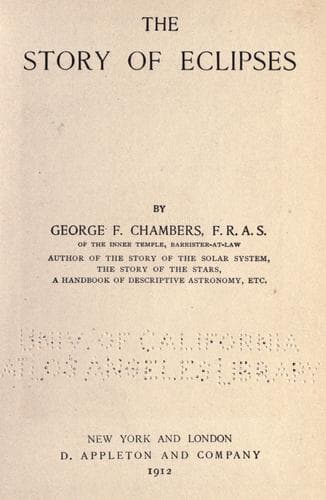
The Story of EclipsesChambers, George F. (George Frederick)
History
The Story of Eclipses
Chambers, George F. (George Frederick)
Eclipses
In the following year, that is to say on April 6, 1875, there was a
total eclipse of the Sun, visible in the far East, especially Siam; but
the distance from England, coupled with the very generally unfavourable
weather, prevented this from being anything more than a second-class
total eclipse, so to speak, although extensive preparations had been
made, and the sum of £1000 had been granted by the British Government
towards the expenses. A certain number of photographs were obtained, but
none of any very great value.
Perhaps of the next eclipse which we have to consider, it may be said
that the circumstances were more varied than those of any other during
the second half of the 19th century. The eclipse in question occurred on
July 29, 1878.
Several favourable circumstances concurred to make it a notable event.
In the first place, the central line passed entirely across the United
States; in other words, across a long stretch of inhabited and civilised
territory, accessible from both sides to a nation well provided with the
requisite scientific skill and material resources of every kind. But
there was another special and rare facility available: the central line
crossed the chain of the Rocky Mountains, an elevated locality, which an
American writer speaks of as overhung by “skies of such limpid
clearness, that on several evenings Jupiter’s satellites were seen with
the naked eye.” On the summit of a certain peak, known as Pike’s Peak, a
party of skilled observers, headed by Professor Langley, observed the
wonderful developments of the Corona, mentioned on a previous page. The
fact that such a display came under the eyes of man was no doubt mainly
due to the superbly clear atmosphere through which the observations were
made. That this is not a mere supposition may be inferred from the fact
that at the lower elevation of only 8000 feet, instead of 14,000 feet,
the Coronal streamers were seen by Professor Newcomb’s party, far less
extended than Langley saw them. Perhaps the best proof of the importance
of a diaphanous sky is to be found in the fact that on the summit of
Pike’s Peak, the Corona remained visible for fully 4 minutes after the
total phase had come to an end. A comparison of the descriptions shows
that even at the elevation of 10,200 ft. the observers placed there,
whilst they were better off than those at 8000 ft., assuredly did not
see so much or so well as those at 14,000 ft.
There occurred a total eclipse on July 11, 1880, visible in California,
but as the totality lasted only 32 secs. and the Sun’s elevation was
only 11°, not much was got out of this eclipse notwithstanding that it
was observed in a cloudless sky at a station 6000 ft. above the sea.
Public-domain text, read in full here on John Shaqi.
Reviews
Reviews
No reviews yet
Be the first to share your thoughts on this work.
Elsewhere in the archive
Join the Discussion
Join the discussion
Sign in to leave a comment or review.
Sign InorCreate an account