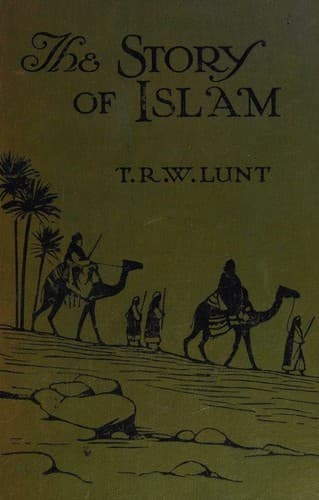
[Sidenote: The Hegira, of Flight to Medina, 622 A.D.]
Abu Bakr was eager to set off, but still the Prophet lingered,
waiting, perhaps, till his followers were all gone; perhaps for some
favourable omen (for he was superstitious to the last); perhaps
dreading the long, toilsome, dangerous journey, or, as he said,
waiting till it was revealed that the time was come. Two swift
camels were bought and kept on high feed in readiness; money in
portable form was prepared; a guide, accustomed to the devious tracks
of the desert, was hired.
At last the night arrived. Stealing through a back window, they
escaped unobserved through a southern suburb in the opposite
direction to Yathreb, and after some hours' wandering, took refuge in
a cave near the summit of Mount Tûr.
They lay in hiding while Mecca raised the hue and cry.
Miracles and legends cluster around that cave and hide its Prophet.
Branches sprouted in the night and hemmed it in on every side, and
wild pigeons lodged upon them. A spider wove its web across the
entrance. Once again Islam hung in {64} the balance. Glancing
upwards at a crevice through which the morning light began to break,
Abu Bakr whispered:
'What if one were to look through the chink and see us underneath his
feet?'
'Think not thus, Abu Bakr,' the Prophet replied; 'we are two, but God
is in the midst, a third.'
Meanwhile scouts had been sent in every direction; but at last,
opining that Mohammed had escaped towards Yathreb by the fleetness of
his camel, they desisted. Then the fugitives came forth, and set out
for their desert journey of four hundred miles.
They were not quite 'out of the wood' yet. They met a scout
returning from the search. A Bedouin encampment where they sought
food held elements of danger. But at length they reached the garden
outskirts of Yathreb, to be known henceforth as El Medina--'The
City'--'The City of the Prophet.' For several days the town had been
in eager and excited expectation of its illustrious visitor. Still,
with his unrivalled restraint, Mohammed waited for four days to
recover from the effects of his journey. On a Friday he made his
state entry amid the cheers of {65} the populace, preached them a
sermon of religious exhortation and eulogy of the new Faith, and in
the midst of a circle of one hundred believers, conducted before all
the people the first great Mohammedan 'Friday Service.' It was in
the year of our era 622 Anno Domini, henceforth the 'First year of
Islam,' the year of the 'Hegira,' or 'departure,' the Flight of
Mohammed from Mecca to Medina.
Ten years of brave struggle, lonely leadership, and self-restraint do
not diminish dignity: Mohammed rode into Medina in all things
fulfilling the highest Oriental idea of the true king.
QUESTIONS ON CHAPTER IV
1. What were the advantages of keeping the Faith secret for some
years? Was it right?
2. Describe Mohammed's mode of life in Mecca. Was it suitable?
Public-domain text, read in full here on John Shaqi.
Reviews
Reviews
No reviews yet
Be the first to share your thoughts on this work.
Join the Discussion
Join the discussion
Sign in to leave a comment or review.
Sign InorCreate an account