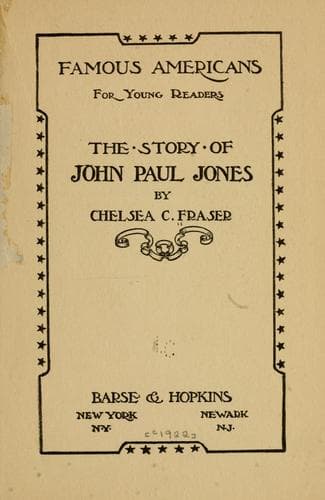
The Story of John Paul JonesFraser, Chelsea Curtis
History
The Story of John Paul Jones
Fraser, Chelsea Curtis
Jones, John Paul, 1747-1792
It must be remembered that at this time the slave-trade was not regarded
as anything dishonorable. Numerous vessels were attracted to it as a
money-making venture, and openly plied back and forth between the home
of the black man and the island of Jamaica. Few sailors, few officers,
few of the people at large, thought it wrong to steal lusty young
negroes and negresses away from their parents and kinsmen and offer them
for sale to the Jamaican slave-dealers and plantation owners.
So young John Paul first engaged in the trade without any compunctions
of conscience. But it was not for long. At the end of two years he had
seen so many broken hearts among the blacks as a result of the forced
partings, had been an observer of so much unnecessary suffering because
of the cruelty of the rough fellows who handled the human freight, that
his heart sickened. In fact, so disgusted was he that he even sold out
the sixth interest which he had obtained in the ship, quitted it, and
boarded the _John O'Gaunt_, at Kingston, Jamaica, bound as a passenger
for Whitehaven.
On the trip home the captain, mate, and all but five of the crew of the
_John O'Gaunt_ died of yellow fever. Not a man was left, except John
Paul, who knew enough about navigation to bring the afflicted ship into
port. So the lad took charge. With neatness and dispatch he guided the
brig across the dangerous waters of the Atlantic and into her haven. Her
pleased owners rewarded him with a share of her cargo, and gratified him
even more by making him captain and supercargo of a new ship--the
_John_--which was engaged in the West Indian merchant trade.
Life on a merchantman is rough enough to-day; it was far rougher at that
time. To maintain discipline at sea required a strong hand and a tongue
none too gentle. Kind-hearted enough by nature, John had learned his
lessons by this time; he knew that indecision and softness had no place
in an efficient skipper's makeup before his men, and while good enough
to his crew at all times he insisted that they obey his commands with
respect and promptness.
During the third voyage of the _John_, when fever had greatly reduced
the crew and every man on board was more or less fretful and irritable,
Mungo Maxwell, a mulatto carpenter, became mutinous to such an extent
that the young commander deemed it advisable to have him flogged, not
only as fitting punishment, but as a salutary example for the
observation of the remainder of the crew. The chastisement duly took
place. It was not unusually severe, but it happened that, unknown to the
youth, the man was just coming down himself with the scourge. He took to
his bed, the fever gripped him, and he never arose again.
Public-domain text, read in full here on John Shaqi.
Reviews
Reviews
No reviews yet
Be the first to share your thoughts on this work.
Join the Discussion
Join the discussion
Sign in to leave a comment or review.
Sign InorCreate an account